Skip to content

A health plan can have a well-functioning, reliable enrollment portal, accurate claims processing rules, and a dedicated service center, yet still issue the wrong ID card or deny a valid claim. This problem often starts upstream, in the 834 enrollment file.
Employers, exchanges, and state agencies send enrollment updates to health plans through EDI 834 transactions. If any of this information is in any way incorrect or incomplete, the error can quickly spread across eligibility, claims, billing, and member services before anyone notices.
Understanding where these errors originate and why they bypass routine EDI validation is the first step toward preventing them.
What is an 834 enrollment file?
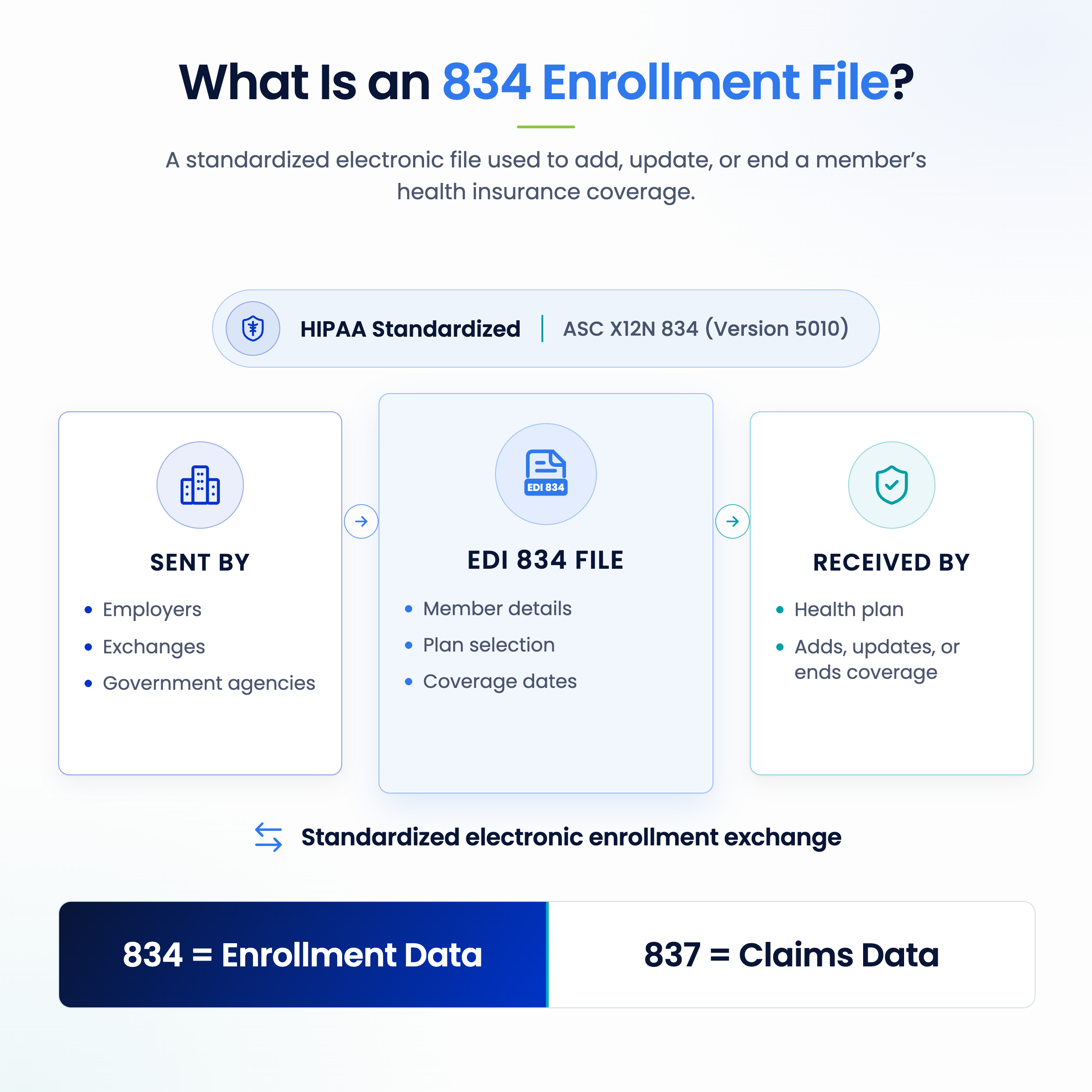
An 834 file in healthcare is a benefit enrollment and maintenance transaction used to electronically exchange information about member coverage between employers, plan sponsors, third party administrators (TPAs), and health plans. Since health plans are covered entities under HIPAA, an 834 file in healthcare must comply with the HIPAA 5010 version of the ASC X12N standard. In other words, an 834 enrollment file is a standardized electronic transaction used to add, update, or terminate a member's health insurance coverage.
Also called an EDI 834, these files typically come from employers, health insurance exchanges, or government agencies. They contain subscriber and dependent information, plan selections, and coverage effective dates. An 834 may transmit a full enrollment population or changes to existing enrollment records, depending on the trading partner's requirements.
Unlike an 837 claim transaction, which communicates healthcare claims, the 834 establishes and maintains the enrollment eligibility against which every claim is adjudicated.
What is inside an 834 file?
The 834 file format organizes enrollment information into structured segments. Payer operations teams need to pay attention to four key components in an 834 file.
| Component | Information/Content | Where errors can occur |
|---|---|---|
| File header | Sender, receiver, transaction details | Incorrect file identification or processing instructions |
| Sponsor and plan details | Employer or agency information, plan identifiers | Incorrect group or plan mapping |
| Member record | Member IDs, demographics, relationships, enrollment changes | Duplicate identities, missing dependents, or incorrect PII |
| Coverage information | Benefit selections, effective and termination dates | Coverage gaps, incorrect benefits, premature termination |
The 834 file layout helps systems identify and process information consistently.
At the same time, a file can be structurally correct without being accurate data-wise. For instance, an 834 file can follow every formatting requirement while still carrying an incorrect coverage date, member ID, or benefit selection. This is why many enrollment errors go unnoticed.
How does an 834 file move through a health plan?
Most 834 files follow a similar operational path, although schedules and processing requirements vary by trading partner.
- Receive: The health plan receives the enrollment file through an agreed secure exchange.
- Validate: The system checks the transaction's structure and the processed format against HIPAA and WEDI SNIP compliance rules.
- Map: Incoming plan, benefit, and relationship codes are translated into the health plan's internal values.
- Update: Member records are added, modified, or terminated based on the incoming information directly into the core database.
- Distribute: Updated enrollment data becomes available to eligibility, claims, billing, ID card, and member-facing systems.
- Resolve exceptions: Rejected or questionable records are investigated and corrected.
The risk increases when incorrect information passes through these stages without being identified, causing claim denials, billing errors and surge in workload.
Why do 834 enrollment file errors go unnoticed?
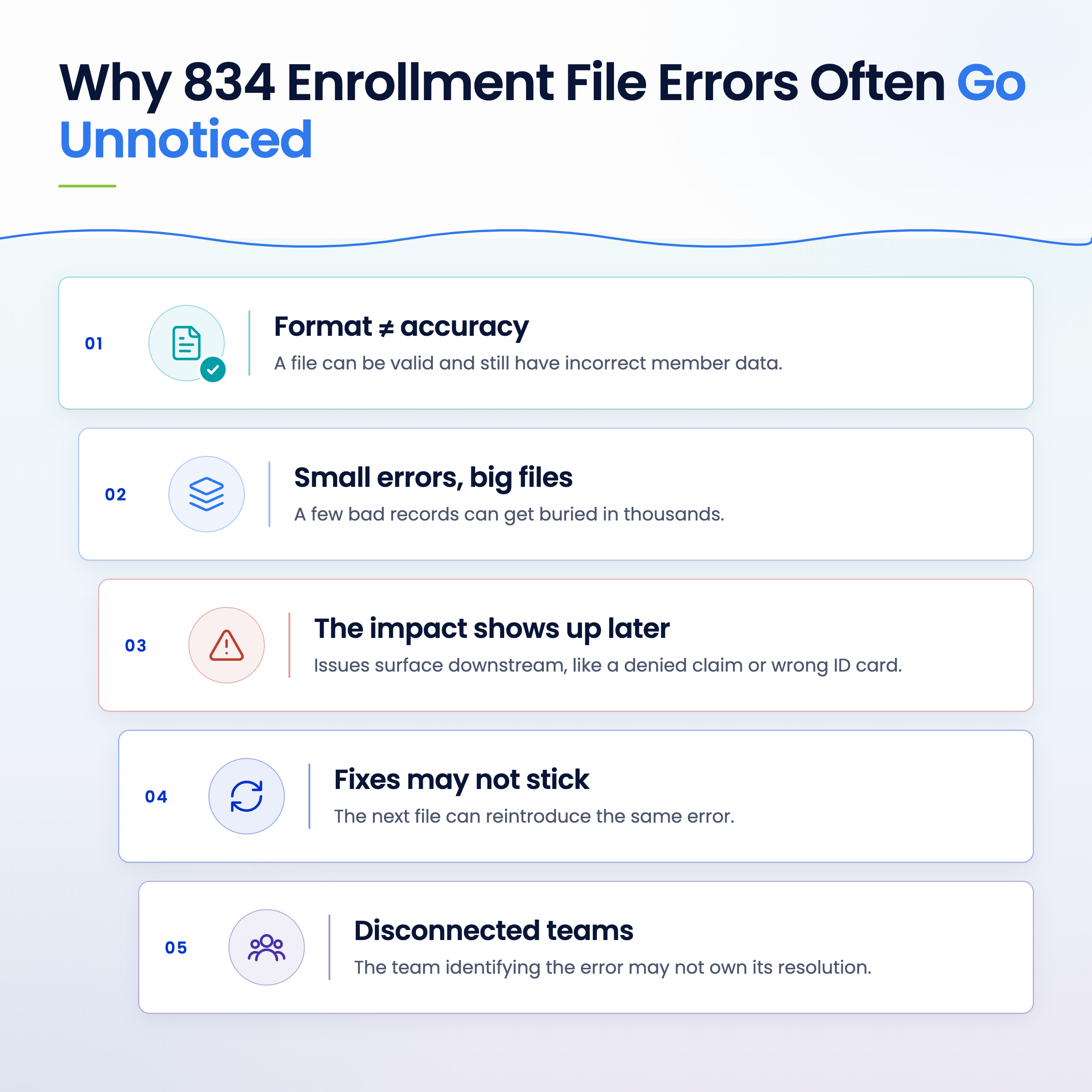
The biggest problem with EDI 834 errors is the delay between their origin and their discovery.
A valid file can contain invalid information. Technical validation checks whether a transaction follows the expected structure. It does not verify whether an effective date, dependent relationship, or benefit package is operationally correct.
Individual errors disappear inside large files. Thousands of enrollment records may be processed together, resulting in some incorrect dates or member IDs escaping routine checks.
The symptoms appear downstream. An enrollment error may first surface as a denied claim, an incorrect ID card, a billing discrepancy, or a member complaint. By this stage, tracing the root transaction back to an EDI segment is manual and time-consuming.
Manual corrections may not address the source. If a health plan corrects a member record internally without updating the trading partner, the next delta file simply overwrites the fix.
Siloed departmental ownership. Furthermore, the team discovering the error is often different from the team responsible for resolving its underlying cause.
Download the EDI 834 Enrollment File Infographic to understand the structure of an enrollment transaction and how it moves toward active coverage.
What causes member data errors in 834 files?
The most common enrollment data problems follow typical, recognizable patterns.
| Common error | What goes wrong | Operational impact |
|---|---|---|
| Incorrect coverage dates | Coverage starts late or ends prematurely | Claims denied or paid against incorrect/terminated coverage |
| Out-of-order updates | An older change overwrites newer information | Incorrect plan or coverage status |
| Duplicate member IDs | Records are duplicated or incorrectly matched | Fragmented member histories |
| Coding errors for dependents | Dependents are missing or assigned incorrect relationships | Dependent eligibility disputes |
| Demographic mismatches | Names, dates of birth, or addresses differ | Failed matching and incorrect communications |
| Incorrect benefit mapping | Incoming codes map to the wrong plan | Incorrect benefits applied |
| Manual re-entry errors | Staff introduce mistakes while correcting rejected records | Data mismatch and audit vulnerabilities |
These problems become particularly difficult during open enrollment, when higher transaction volumes and tighter processing windows increase operational pressure.
What do 834 errors cost health plans?
The impact of inaccurate enrollment data is rarely confined to the enrollment department. Claims teams investigate denials caused by incorrect coverage information. Member service representatives handle complaints about eligibility, ID cards, and billing. Enrollment teams reconcile discrepancies with sponsors, while compliance teams may need to reconstruct how a record changed to produce audit trails. Each issue creates additional work across multiple departments.
The true costs lie in repeated corrections, delayed resolution, and the time spent tracing an error back to its original transaction.
How can health plans catch 834 errors earlier?
For health plans to spot 834 errors sooner rather than later, the objective should be to identify incorrect enrollment information the moment a file arrives.
- Validate data, not just file structure. Check coverage dates, member identifiers, relationships, and benefit selections against applicable clinical and business rules.
- Reconcile incoming files with existing records. Compare enrollment counts, additions, terminations, and other relevant totals before and after processing.
- Check changes against the current member record. Flag updates that conflict with existing information, reverse recent changes if required, or introduce unexpected coverage gaps.
- Assign ownership to every exception. Assign questionable records to a responsible team, with determined resolution SLAs, and a defined follow-up process.
- Maintain a complete audit trail. Record which source file introduced a change, when it was processed, and how subsequent corrections were made.
- Monitor recurring errors by trading partner. Identify sponsors or file types that have shown a pattern of generating discrepancies so problems can be corrected at the source.
Together, these controls help enrollment teams detect errors earlier, reduce repeated manual corrections, and prevent inaccurate data from spreading across workflows and systems.
How can enrollment software help prevent downstream errors?
Manual checks alone cannot suffice, and are not even possible, when health plans manage large enrollment volumes across commercial, ACA, Medicare, and Medicaid programs. AI-powered health insurance enrollment software can support earlier validation, member matching, change reconciliation, exception management, and traceability. The most important part to remember is to keep enrollment information connected to the systems that depend on it.
HealthAxis addresses this through HealthOS Enrollment, the NOVA-guided enrollment workspace within its Enterprise Healthcare Operating System™ (EHOS). Built on the principle of connected payer operations, the workspace instantly supports the movement from raw 834 files to active coverage, with related information available to the CAPS and Plan workspaces without waiting for the next batch cycle.
For health plans evaluating health plan enrollment software, the priority is to maintain accurate, traceable member information across enrollment and downstream operations - not simply speed up the processing of incoming files.
Frequently asked questions
An 834 file is a standardized electronic transaction used to add, update, or terminate health insurance enrollment. It communicates member and coverage information between enrollment sponsors and health plans.
Employers, health insurance exchanges, government agencies, and third-party administrators send 834 files to health plans.
Common causes include incorrect coverage dates, duplicate member IDs, demographic mismatches, dependent coding errors, outdated updates, and incorrect plan mapping.
An 834 communicates enrollment and coverage information. An 837 communicates healthcare claims. Claims auto-adjudication depends on accurate enrollment and eligibility records.
Frequency depends on trading-partner agreements and operational requirements. Files may arrive daily, weekly, monthly, or according to enrollment volume.
Software can detect many inconsistencies, flag questionable records, and support resolution workflows. However, some errors require confirmation from the enrollment sponsor or manual review to protect data integrity.
Catch enrollment errors before they spread
Incorrect member data can create problems across claims, eligibility, billing, and member services long after the original file was processed.
HealthOS Enrollment unifies ingestion of raw 834 files with real-time operations to eliminate exceptions before they impact the members.
Schedule a DemoSchedule a Demo to explore how HealthOS Enrollment can support more connected workflows.