Skip to content

A healthcare knowledge graph provides a structured representation of the relationships connecting members, providers, claims, benefits, and authorization details. By deploying a shared knowledge graph across a unified operational data core, health plans enable every administrative function and AI agent to access a single, synchronized record rather than relying on fragmented data replicas.
Take an eligibility adjustment as an example. A retrospective correction directly influences coverage status, active claim adjudications, benefit configurations, and provider reimbursement. Operating these administrative capabilities within isolated software applications requires integrations and manual reconciliation to ensure accurate data transmission and interpretation. The underlying challenge stems from the fragmented system architecture and not lack of departmental efforts.
This article explores the operational role of healthcare knowledge graphs, contrasts them with traditional data integration methods, examines why a consolidated data core outperforms disparate point solutions, and highlights key considerations for health plans evaluating adoption.
Key takeaways
- Connected operational entities: Healthcare knowledge graphs map stakeholders including members, providers, claims, and benefit structures alongside the contextual relationships connecting them.
- Complementary data architecture: Traditional data integration handles information transfer between systems, whereas knowledge graphs define conceptual connections to support contextual reasoning across workflows.
- Unified operational foundation: Consolidating disparate point solutions onto a shared data core eliminates the manual synchronization and administrative overhead required by isolated data replicas.
- Enhanced intelligence capabilities: AI agents generate more accurate recommendations when granted cross-functional visibility into enrollment, benefit configurations, provider records, and claim adjudications.
- Prerequisites for deployment: A knowledge graph depends directly on rigorous data governance, precise identity resolution, and information quality rather than functioning as a standalone solution for data integrity.
What is a healthcare knowledge graph?
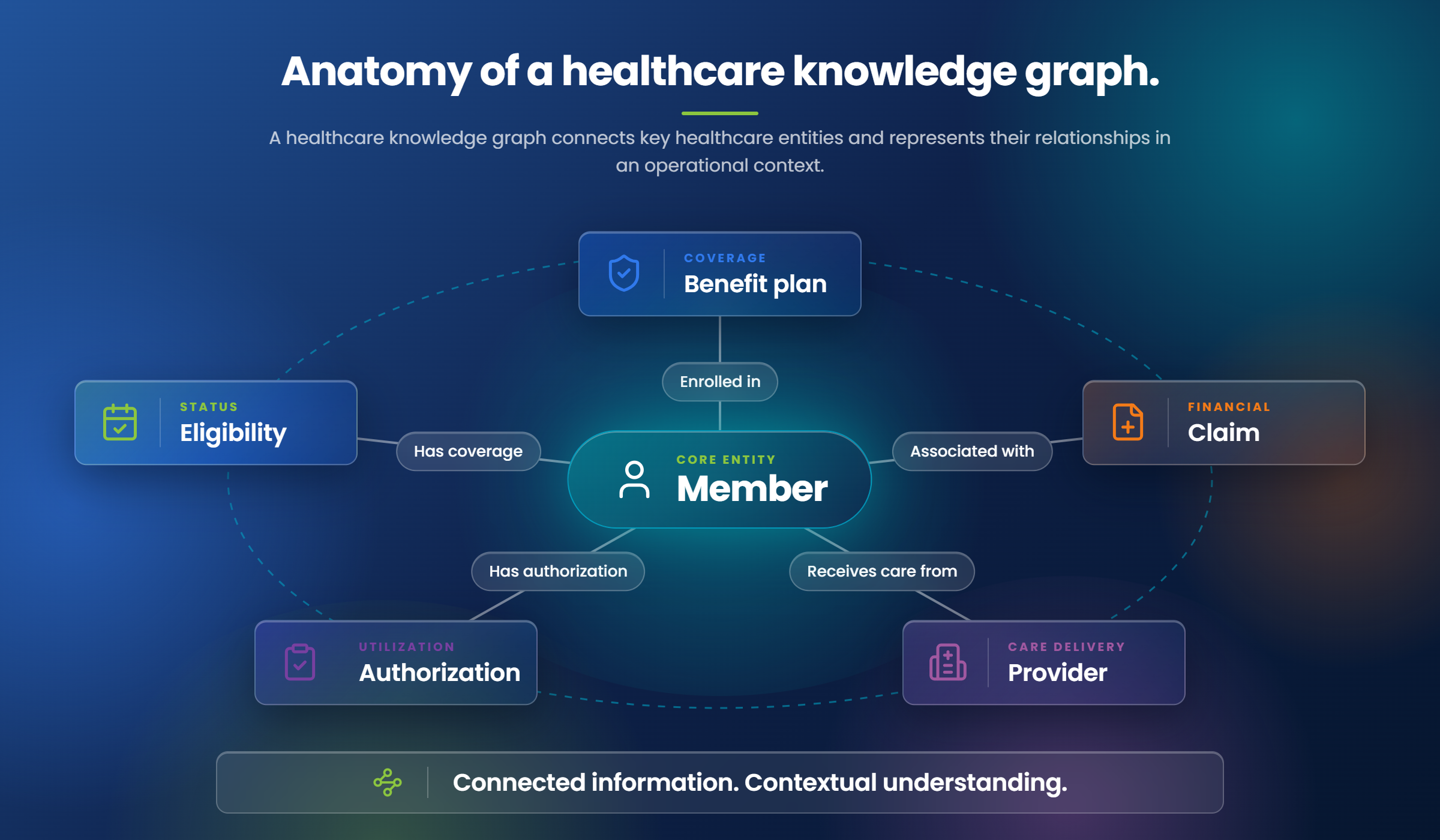
A healthcare knowledge graph is a structured representation of stakeholders in healthcare and the relationships between them. It allows applications and AI systems to understand how different records relate to one another and interpret information within a relevant operational context.
A traditional claims record, for instance, contains information about a healthcare transaction. A knowledge graph connects that transaction to the member's coverage, the provider rendering the treatment, applicable benefits, authorization records, and other relevant information.
Three fundamental components make this possible:
| Component | Definition | Healthcare payer example |
|---|---|---|
| Entities (nodes) | Objects represented in the knowledge graph | Members, providers, claims, benefit plans |
| Relationships (edges) | Connections between entities | A member is enrolled in a benefit plan |
| Attributes | Information describing entities or relationships | Coverage effective date, claim status, enrollment type |
These relationships help systems retrieve and interpret information in context rather than examine individual records in isolation. For health plans, the value of a healthcare knowledge graph lies in connecting this contextual understanding to the administrative processes that govern coverage, healthcare services, and payments.
Why do separate healthcare applications create operational data silos?
Health plans often implement specialized applications for auto-adjudicating claims, managing provider networks, enrolling members, and ensuring payment integrity, ideally before a claim is paid. Each application may perform its designated function effectively while maintaining a separate representation of operational data.
The challenge arises when a transaction requires information or action across multiple applications.
Separate applications require constant data reconciliation
Applications use different data models, validation rules, and batch processing schedules. Health plans must reconcile these differences daily to maintain consistency across operational records. For example, an eligibility correction may arrive in the enrollment system and still not become available to claims administration or member services.
Cross-functional workflows need additional coordination
Resolving a claims exception entails retrieving enrollment records, verifying provider information, reviewing benefit configurations, and examining authorization details across several applications. With every additional handoff, another point at which delays or inconsistencies can occur is introduced.
Fragmented data limits AI capabilities
The effectiveness of an AI agent depends, to a considerable extent, on the data and information it can access. An AI agent reviewing a claim without access to the applicable eligibility, authorization, or benefit information will lack the context required to recommend an appropriate action. Automating individual functions improves departmental efficiency. However, it seldom resolves the underlying fragmentation between those functions.
How does a shared knowledge graph differ from traditional healthcare data integration?
Healthcare data integration enables applications to exchange and consolidate information. A healthcare knowledge graph, on the other hand, serves a different but complementary purpose: it represents the relationships between that information.
Understanding this distinction is important when evaluating healthcare data architecture.
| Architectural approach | Primary purpose |
|---|---|
| APIs and system integrations | Enable applications to exchange information |
| Data warehouses | Consolidate information for reporting and analysis |
| Shared operational data core | Provide consistent records across operational workflows |
| Enterprise knowledge graph | Represent relationships and support contextual reasoning |
A knowledge graph can draw information from existing databases, application programming interfaces (APIs), data warehouses, and other enterprise data sources. Combining a healthcare knowledge graph with a shared operational data core creates an additional capability: applications can access common operational records, while AI agents can interpret the relationships between those records to support decisions.
Healthcare data interoperability alone does not guarantee consistent operational decisions. Applications may successfully exchange information while maintaining different interpretations of that information. The objective for health plans, therefore, should be to establish an architecture in which data consistency and contextual intelligence directly support operational workflows.
Why is one shared data core better than six disconnected point solutions?
Specialized applications can address specific administrative requirements effectively. However, connecting multiple independently deployed applications multiplies integration, reconciliation, maintenance, and governance requirements. A shared data architecture addresses these requirements at the platform level rather than separately within each application.
The advantage of a shared healthcare knowledge graph goes beyond reducing integration complexity. When operational functions use the same data foundation, they can interpret transactions within a broader enterprise context. For example, claims administration can account for relevant changes in enrollment, provider directory, and benefit configurations without relying exclusively on separate data synchronization processes. This creates a foundation for more consistent administrative decisions and coordinated automation across the health plan.
What are the operational benefits of knowledge graphs in healthcare?
Examining how a single administrative transaction affects multiple payer functions makes the benefits of a healthcare knowledge graph clearer. Let's say a health plan validates a retrospective correction to a member's coverage effective date. In a shared data architecture, each relevant function can access the corrected record and interpret its implications within the appropriate operational workflow.
| Operational function | How shared data supports the function |
|---|---|
| Enrollment | Records the validated coverage correction and effective date |
| Claims administration | Identifies affected claims for evaluation against updated eligibility and benefits |
| Provider management | Supports credentialing verification and payment workflows |
| Plan operations | Makes corrected information available for applicable program administration and reconciliation |
| Member experience | Provides access to updated coverage information and relevant claim status |
| Payment integrity | Supports the identification and review of potentially improper payments associated with the correction |
The knowledge graph represents the relationships between the different functions and how they are supported by the shared data foundation. The operational platform determines what actions those relationships warrant under the health plan's established rules.
Not every correction requires intervention across all six functions. The differentiating factor of connected healthcare data is that each function can access the relevant information in real time.
How does a healthcare knowledge graph support agentic AI?
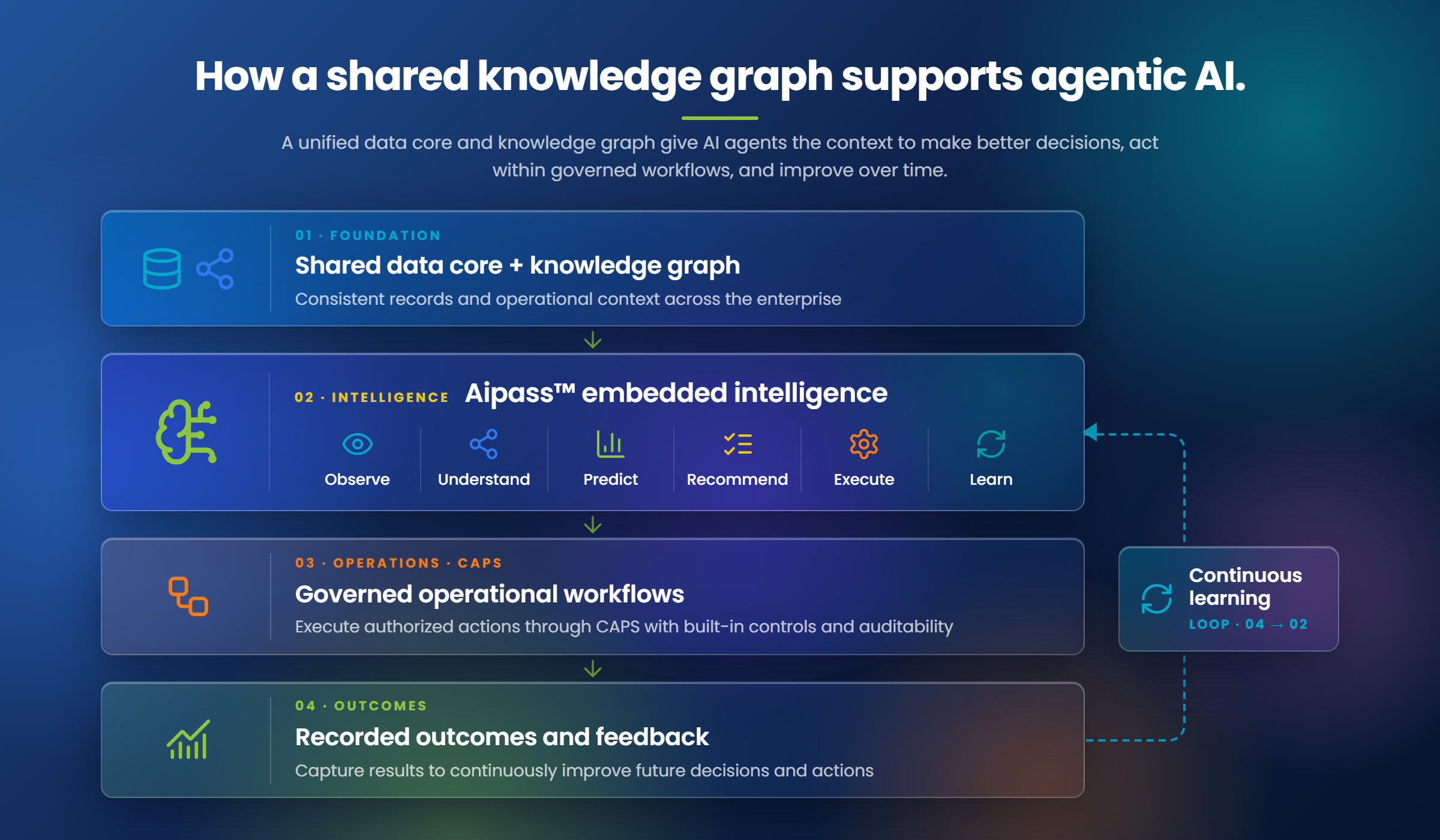
Agentic AI refers to AI systems that coordinate multiple actions toward a defined objective within established permissions and operational controls. In healthcare payer operations, these actions may include retrieving records, investigating discrepancies, gathering supporting evidence, recommending corrections, and initiating permitted workflow steps.
A healthcare knowledge graph supports these capabilities in three important ways.
More complete operational context
A knowledge graph enables AI agents to examine live relationships between claims adjudication, member enrollment and services, provider network management, authorization records, and applicable benefits in a single query. An agent investigating a claims exception can use these relationships to fetch relevant information and identify dependencies that extend beyond the claim itself.
Better-informed recommendations
Connected information helps AI agents assess discrepancies in the appropriate context. For instance, an agent investigating a potential duplicate claim can examine previous transactions, provider information, and relevant coverage details before recommending further review.
A recommendation or risk score, however, does not establish that a payment is improper. The health plan must validate the finding against applicable rules and supporting evidence.
Coordinated and governed execution
When AI operates within connected administrative workflows, it executes authorized actions based on the live information it retrieves and interprets. EHOS by HealthAxis logs these actions, their rationale, and their outcomes in an immutable audit trail. Where a decision requires additional authorization or professional judgment, the system routes it for appropriate human review.
A shared healthcare knowledge graph therefore provides context for AI-supported decisions, while the operational platform provides the workflows and controls necessary to act on them.
For a closer look at practical AI applications and their governance requirements, read our guide to agentic AI in healthcare payer operations.
How does HealthAxis connect six workspaces through one shared knowledge graph?
HealthAxis addresses the fragmentation of healthcare payer operations through its Enterprise Healthcare Operating System (EHOS). EHOS consists of four architectural layers that operate on a common data model, with Aipass™ serving as the intelligence layer running across all four.
| Architectural layer | Primary role |
|---|---|
| Foundation | Provides a common data, integration, infrastructure, and security layer |
| Operations | Processes administrative transactions through HealthOS and CAPS |
| Intelligence | Aipass™ interprets information, predicts risk, and recommends actions |
| Experience | Delivers role-based experiences to healthcare stakeholders |
HealthOS, the operational backbone of EHOS, brings six purpose-built workspaces together on one shared data core.
- HealthOS CAPS: Claims, eligibility, benefits, authorizations, and core administration.
- HealthOS Plan: Medicare and government program operations.
- HealthOS Provider: Provider network management and operations.
- HealthOS Member: Member experience and engagement.
- HealthOS Enrollment: AI-guided enrollment and eligibility management.
- HealthOS Sentinel: Fraud, waste, and abuse (FWA) detection, payment integrity, and SIU claim review.
Every workspace reads and writes to the same live record. A validated change in HealthOS Enrollment becomes available to HealthOS CAPS and HealthOS Member without waiting for a separate synchronization cycle.
One intelligence engine across six workspaces
Aipass™ is the intelligence engine embedded across the EHOS architecture. It operates from one shared knowledge graph rather than functioning as a separate, siloed AI bot within each workspace. It observes operational activity, understands information in context, predicts outcomes, recommends actions, supports execution through CAPS, and learns from recorded outcomes.
This architecture connects intelligence directly to administrative transactions. Health plans can use AI not only to identify operational issues but also to support their resolution within governed workflows.
Modular adoption without complete system replacement
Health plans are not required to deploy all six operational workspaces simultaneously. Organizations can selectively introduce individual modules into their current architecture, scaling capabilities without disruptive core replacement. HealthOS seamlessly connects with existing technology through standardized integration frameworks, including Electronic Data Interchange protocols and HL7 FHIR standards. As regulatory frameworks like the CMS Interoperability and Prior Authorization final rule (CMS-0057-F) mandate expanded API functionality for impacted payers, maintaining unified operational records becomes paramount. To explore the practical implications of these regulatory changes, review our analysis on CMS-0057-F and interoperability beyond compliance, which demonstrates how this consolidated architecture natively powers required FHIR APIs.
For a detailed visual overview, examine our infographic, Healthcare Knowledge Graph: Six Workspaces, One Data Core. To understand the broader strategic rationale, read our guide on why health plans are moving to a single operating system.
What should health plans consider before adopting a shared data architecture?
A healthcare knowledge graph does not automatically resolve every data quality or interoperability problem. Its reliability depends on the accuracy, completeness, and relevance of the information and relationships it represents. A 2023 systematic review identified knowledge extraction, data integration, and information quality as important considerations in healthcare knowledge graph construction.
Health plans should consider the following when adopting a shared data architecture:
- Data quality: Establish processes for validating, correcting, and maintaining operational records.
- Identity resolution: Accurately identify and associate members, providers, and other entities across data sources.
- Interoperability: Ensure compatibility with existing applications and external healthcare systems.
- Data provenance: Maintain visibility into the origin, history, and modification of operational information.
- Security and governance: Establish access controls, audit requirements, and appropriate permissions for AI-supported actions.
Health plans should evaluate their technology investments not only by what individual applications can accomplish but also by how effectively those applications operate together.
The future of healthcare administration depends on connected operations
A shared healthcare knowledge graph changes what is possible across the enterprise. It allows functions to interpret information in context, AI agents to support decisions across workflows, and health plans to undertake operations modernization without repeatedly introducing new data silos.
Through EHOS, HealthAxis brings together six connected HealthOS workspaces, one shared data core, and Aipass™ as the embedded intelligence layer. This architecture enables health plans to modernize their operations at a pace that suits them while establishing a common foundation for operational efficiency, governed automation, and enterprise-wide AI.
The ultimate goal is not simply to automate isolated healthcare processes. It is to enable the entire enterprise to operate with greater consistency, intelligence, and coordination.
Frequently asked questions
A healthcare knowledge graph is a structured representation of healthcare entities and stakeholders and their relationships. It connects information about members, providers, claims, benefits, diagnoses, authorizations, and policies, enabling applications and AI systems to retrieve and interpret information within the appropriate operational or clinical context.
Traditional databases typically organize information into tables and connect records through defined keys. A healthcare knowledge graph explicitly represents entities and their relationships, making it particularly useful for exploring complex connections and supporting contextual reasoning. Both technologies can operate together within an enterprise data architecture.
Health insurers can use knowledge graphs to connect claims, eligibility records, provider information, benefit configurations, and authorization data. These relationships can support claims adjudication, payment integrity investigations, enrollment validation, and AI-assisted administrative workflows by making relevant information available in context.
Knowledge graphs provide AI agents with structured information about relationships between healthcare entities. This context helps agents retrieve relevant records, investigate discrepancies, and recommend appropriate actions. When integrated with governed operational workflows, knowledge graphs can also support AI-assisted execution and coordinated exception resolution.
Yes. Healthcare knowledge graphs can incorporate information from existing databases, legacy applications, APIs, and standardized healthcare transactions. Successful integration depends on accurate data mapping, identity resolution, interoperability capabilities, and appropriate governance. Organizations do not necessarily need to replace their entire technology infrastructure to adopt knowledge graph capabilities.
No. HealthOS supports modular adoption, allowing health plans to implement one or more workspaces alongside their existing systems. Its six connected workspaces operate on a shared data core, with Aipass™ embedded across all six. Health plans can expand their adoption according to their operational priorities and modernization requirements.