Skip to content
In modern health plan administration, data rarely stays in its lane. Enrollment affects claims, provider data shapes member service, and payment integrity touches everything. Yet most plans still run these functions in separate systems. Although the purposes these functions serve vary greatly, they heavily depend on information produced elsewhere in the organizational workflows.
A healthcare operating system (OS) brings the much-needed coherence to these seemingly disjointed functions. It is able to do this by giving health plans a common environment for connecting administrative data, workflows, applications, governance, and AI - similar to what a conventional operating system like macOS or Windows does for software. The goal is to enable health plans to eliminate the need for each function to operate in silos.
The need for a healthcare OS has heightened even more in the age of AI. Software is being increasingly tasked with not only processing transactions but also to interpret information, recognize patterns, recommend actions, automate appropriate work, and identify situations that require human attention. Those capabilities are heavily dependent on the context available to them. HealthAxis brings this model to life with the Enterprise Healthcare Operating System™ (EHOS), a system built on a transformative four-layer architecture. By bringing six purpose-built workspaces - CAPS, Enrollment, Plan, Provider, Member, and Sentinel - onto a shared data core, it keeps specialized administrative systems deeply connected. With Aipass™, the platform's embedded intelligence engine, shared context is engineered into every interaction, allowing data, workflows, and intelligence to operate with an unbroken, enterprise-wide perspective.
Through this article, readers will gain a comprehensive understanding of why health plans are well positioned to adopt an OS designed for healthcare, how EHOS connects the most critical functions of payer administration, and why shared operational context becomes increasingly important as AI takes a larger role in healthcare administration.
What Is an Enterprise Healthcare Operating System?
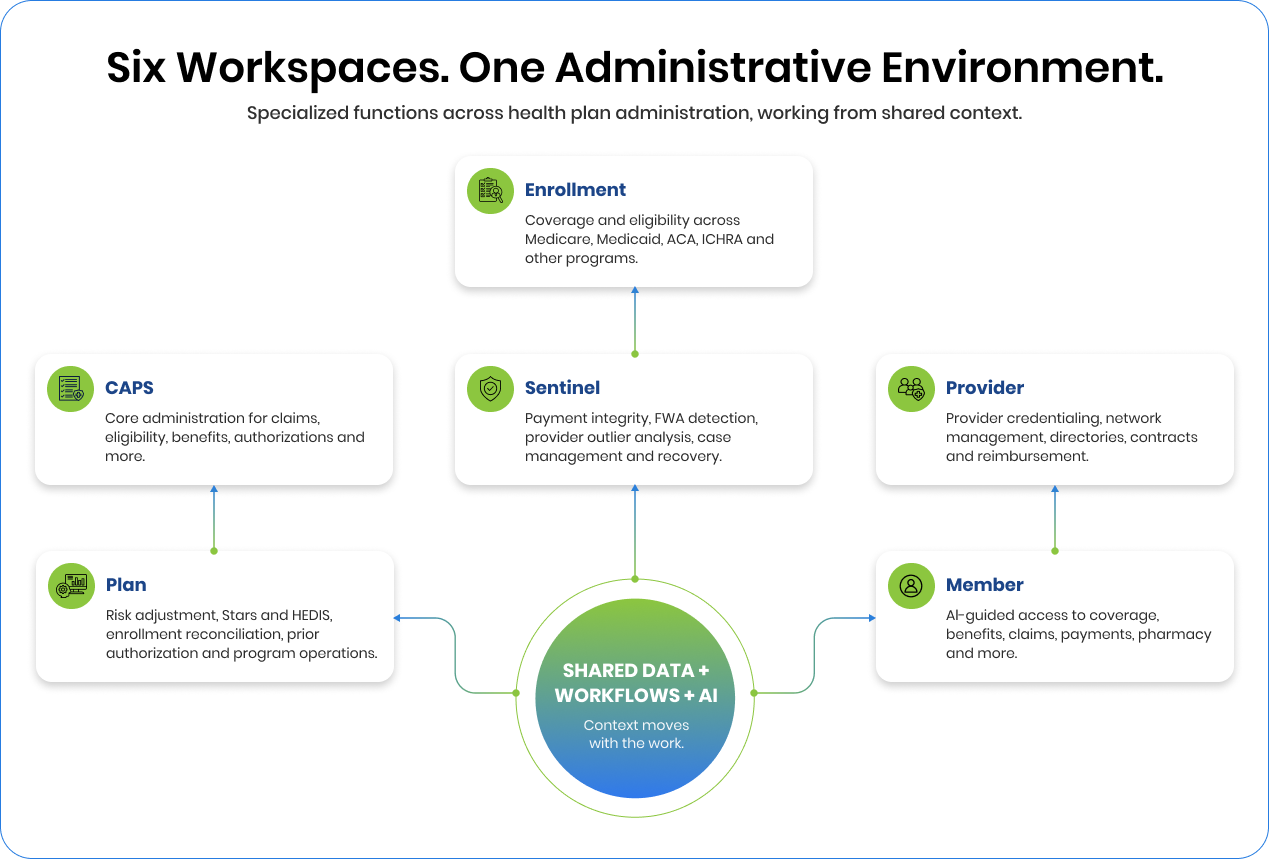
In simplest terms, an operating system refers to the foundational environment that allows a wide array of applications, data, and services to work together. It is the core layer of a computer that manages how these diverse components exchange information, access shared resources, and interact with each other. An OS is therefore distinct from the applications that run on it - the former is the foundation on which the latter are designed to perform specialized functions.
Applied to healthcare, the utility of the analogy is apparent without being literal. Health plans have spent decades and dollars adopting specialized healthcare payer software, because claims, enrollment, provider management, payment integrity, quality, member service, and other functions require specialized capabilities. The interoperability gap appears when those functions need to understand the same member, provider, transaction, or decision differently - or at different times.
This gap has made interoperability even more important than before, cemented by the publication of the Centers for Medicare & Medicaid Services (CMS) on this topic. In January 2024, the CMS released the CMS Interoperability and Prior Authorization final rule (CMS-0057-F). Under it, impacted payers such as Medicare Advantage (MA) organizations and are required to implement and maintain certain Health Level 7® (HL7®) Fast Healthcare Interoperability Resources® (FHIR®) application programming interfaces (APIs) to improve the electronic exchange of health care data, as well as to streamline prior authorization (PA) processes.
This final rule is vital for data cohesion because it enables information exchange. The remaining challenge for health plans is ensuring that exchanged information remains meaningful and usable as administrative work continues.
Why Does AI Need Connected Health Plan Data?
The reason is quite simple: AI can only reason from the context it has access to.
A model evaluating a claim may need more than just foundational data. For example, an AI supporting provider operations will need credentialing, network, contracting, and transaction context. On the other hand, an AI-guided member-service solution should have access to current enrollment, benefits, provider, and claims information to answer a question accurately. What these instances testify to is that eligibility, benefits, authorization, provider status, previous transactions, and payment-integrity signals can collectively impact how the same transaction can be understood.
Slapping AI onto a disconnected tech stack just builds "smart islands." It might accelerate a single task, but the informational walls remain. That model completely breaks down with agentic AI. Take claims adjudication. AI agents need a 360-degree view to connect data, trigger multi-step workflows, and know when to involve a human. If the systems don't talk to each other, AI agents can't either.
How Does EHOS Connect Health Plan Administration?
EHOS solves the workflow fragmentation challenges in payer administration by providing a connected operating environment - not as a collection of unrelated applications. All six HealthOS workspaces read from and write to the same live data core. If there is a change in enrollment, for example, it will become visible across the other workspaces without the system having to wait for a separate processing cycle. EHOS also supports EDI 837, 835, 270 and 271 transactions and HL7 FHIR R4 for connectivity with external healthcare systems.
It features four principal components:
- A four-layer architecture consisting of Experience, Intelligence, Operations, and Foundation.
- Six specialized administrative workspaces for core administration, enrollment, provider operations, plan management, payment integrity, and member engagement.
- A shared data foundation through which relevant member, provider, claim, and encounter context can remain available across those workspaces.
- Aipass™, the intelligence layer embedded across EHOS.
The true differentiator lies in what happens to the information after a workflow completes. An enrollment decision directly informs claims processing, while an update in the Provider workspace immediately impacts network and reimbursement operations. The EHOS is built specifically for this reality, ensuring data doesn't just settle into isolated systems, but actively powers the next decision.
What Do the Six Workspaces Do?
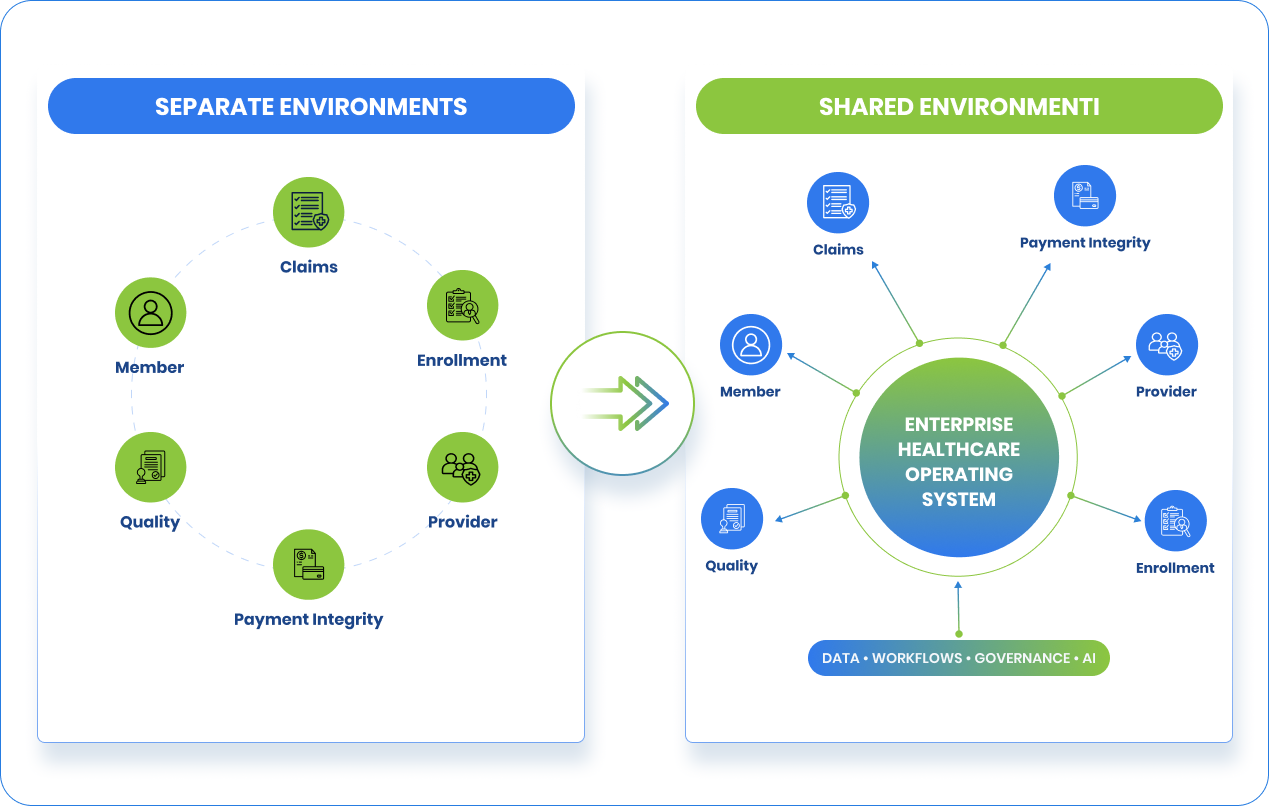
Each workspace in the HealthOS Suite addresses a different operation of health plan administration.
HealthOS CAPS
This functions as the core administrative engine within HealthOS, supporting claims adjudication, eligibility, benefits, authorizations, member and provider administration, and related core functions. In terms of functioning, CAPS looks after claims and encounter activity that subsequently become context for the other workspaces. Instead of viewing claims processing as a separate activity, the operating model enables the transaction to retain the administrative context within which it took place.
HealthOS Enrollment
Guided by NOVA, the intelligent, omnichannel contact center that handles live member and provider conversations, this workspace provides the health plan enrollment software necessary for identity verification, eligibility determination, plan selection, application processing, and enrollment workflows across Medicare, Medicaid, ACA, ICHRA, and other programs. Once it establishes coverage, CAPS can use that information for eligibility and claims administration. Additionally, Plan can use it for reconciliation and program operations, and Member can reflect the resulting coverage state.
HealthOS Provider
Provider workspace combines capabilities of provider credentialing software and provider data management, including enrollment, directories, network management, referrals, contracts, and reimbursement. A credentialing or network-status change is likely to have ramifications across claims configuration, reimbursement, directories, referrals, and member-facing information. Connecting these functions to the broader operating environment allows provider information to remain relevant, particularly in cases where the relationship can affect another decision in another workspace.
HealthOS Plan
This dedicated plan workspace supports risk adjustment, Stars and HEDIS, enrollment reconciliation, prior authorization, and government-program operations. Unlike standalone risk adjustment software, a connected model can bring risk and quality workflows closer to the claims, encounters, enrollment, provider, and member information on which they depend. The objective is to bridge the divide between plan analysis and operations underlying it.
HealthOS Member
Member workspace provides AI-guided access to coverage, benefits, claims, payments, pharmacy information, and other self-service functions. Because the workspace exists and operates in the same broader environment, information presented to the individual reflects the administrative context being used elsewhere. A claim or coverage question therefore does not need to begin as a new information problem simply because the interaction has shifted to a different channel.
HealthOS Sentinel
This is the sixth workspace that supports pre-payment review, fraud, waste & abuse (FWA) detection, provider outlier analysis, case management, post-payment recovery, and other healthcare payment integrity functions. A routine claim viewed alongside provider behavior, eligibility, coding patterns, member history, and previous claims may warrant additional review. Connection with CAPS allows payment-integrity determination to occur beside adjudication, while review outcomes can contribute additional context to future activity.
How Does Work Move Across a Single Operating System?
Take the case of an ordinary member journey.
- Enrollment establishes coverage. Identity, eligibility, plan selection, and coverage information enter the administrative record.
- CAPS uses that context during core administration. When a transaction arrives, eligibility, benefits, authorization, and other relevant information inform processing.
- Provider contributes network and reimbursement context. Provider relationships can shape how the transaction is ultimately handled.
- Sentinel evaluates payment-integrity signals. The transaction is tracked alongside wider member, provider, coding, and historical information before or after payment, based on the workflow.
- Plan uses information from the resulting administrative activity. Claims, encounters, enrollment, and other information contribute to risk adjustment decisions, quality, reconciliation, and program operations.
- Member presents the administrative history. If a member wishes to review the claim or ask a question, the interaction can draw from the context accumulated during the earlier stages.
The vision behind HealthOS is that several functions can be a part of the same member and transaction history without each one having to rebuild an entirely separate version of that journey from scratch.
How Does Aipass™ Make EHOS Smarter?
Aipass™ is the intelligence engine embedded across all six HealthOS workspaces. It brings together natural-language processing (NLP), predictive analytics, decision intelligence, generative AI (genAI), automation, and a shared knowledge graph built around member, provider, claim, and encounter information.
Its position within the architecture is what distinguishes it from other bolted-on AI solutions or tools. Rather than adding a separate AI tool to each of the six workspaces, Aipass™ operates across EHOS. It can:
- Observe and identify changes, patterns, or anomalies.
- Understand an event using relevant operational context.
- Predict likely outcomes or areas requiring attention.
- Recommend the next best action.
- Execute or automate routine steps when rules and confidence permit.
- Escalate ambiguous, suspicious, unusual, or higher-value cases for human review.
Through these capabilities, Aipass™ lays the foundation for agentic AI healthcare workflows while keeping human-in-the-loop (HITL) principles in place.
What Are the Limits of AI in a Healthcare Operating System?
A connected healthcare OS can provide AI with more context, but more context does not, and should not, translate to automating every decision. Healthcare administration involves decisions related to coverage, payment, compliance, provider relationships, and member interactions. The consequences vary substantially from one workflow to another, and human judgment remains important for exceptions - cases that deviate from the established rules, evidence requirements, confidence levels, or predictable consequences. Beyond workflows and operational considerations, what matters most is delivering care to those who need it the most. This is why the question of using AI responsibly, particularly in healthcare, has never been more pressing.
Policy-level measures have sought to address this. In January 2023, for instance, the National Institute of Standards and Technology (NIST) published the AI Risk Management Framework (AI RMF), a voluntary framework intended to "offer a resource to the organizations designing, developing, deploying, or using AI systems to help manage the many risks of AI and promote trustworthy and responsible development and use of AI systems." The standards are intended to be "rights-preserving, non-sector-specific, and use-case agnostic, providing flexibility to organizations of all sizes and in all sectors."
For health plans, these principles translate into practical questions such as:
- What information was available to the AI?
- Why did it recommend or take a particular action?
- What permissions govern the information it can access?
- What level of confidence is required before automation is allowed?
- Which decisions require human review?
A credible healthcare AI platform therefore needs governance alongside intelligence. The objective is not maximum autonomy; it is appropriate automation with enough evidence and oversight to understand how an outcome was reached.
Envisioning a New Standard for Health Plan Administration
Shifting toward an enterprise healthcare operating system does not mean replacing existing systems or collapsing all functions into a single application. The reliance of health plans on specialized technology for claims, enrollment, provider management, payment integrity, risk adjustment, and other complex functions is likely to continue. What will change is how these capabilities work in unison. As data volumes grow exponentially, information moves at an unprecedented pace, and AI takes on a greater role in interpreting information and coordinating action, the value of each system increasingly depends on the context it can access outside of its predefined boundaries.
That is the model behind EHOS and its comprehensive suite of specialized workspaces, designed for health plans to adopt it gradually, connecting existing technology wherever necessary and expanding based on the evolution of operational needs. The next phase of health plan modernization is thus taking a definitive shape: creating an environment in which the applications, data, workflows, and intelligence already across the enterprise can work as a unified whole to provide care with efficiency, economy, and, above all else, empathy.
Frequently Asked Questions
An enterprise healthcare operating system is an architectural environment that connects specialized healthcare applications through shared data, workflows, governance, interoperability, and intelligence. For health plans, risk-bearing providers and government programs, the model is intended to preserve administrative context as work moves across functions such as enrollment, claims, provider operations, payment integrity, plan management, and member service.
HealthOS is HealthAxis's operating system suite, with dedicated expertise verticals, for health plan administration. It consists of six purpose-built workspaces - CAPS, Plan, Provider, Member, Enrollment, and Sentinel running on a shared data core, with Aipass™ embedded across the environment as its intelligence layer.
Healthcare payer software typically specializes in a particular administrative function, such as claims processing, enrollment, provider management, risk adjustment, or payment integrity. A healthcare operating system provides a common environment through which those specialized functions can share relevant data and operational context while retaining their individual capabilities.
Aipass™ is the intelligence layer embedded across all six HealthOS workspaces. HealthAxis states that it uses a shared knowledge graph and capabilities including natural-language processing, predictive analytics, decision intelligence, generative AI, and automation to support workflows using connected member, provider, claim, and encounter context.
HealthOS includes CAPS, its core administration workspace, but the platform is designed for modular adoption and standards-based integration rather than requiring every existing system to be replaced at once. HealthAxis states that workspaces can be adopted individually and that HealthOS supports HL7 FHIR R4 and common healthcare EDI transactions.
Agentic AI can perform or coordinate multi-step actions, which makes the completeness and governance of its operational context particularly important. Connected data can give an agent access to relevant information across a workflow, while permissions, auditability, confidence thresholds, and human-review rules help determine what the agent is allowed to do.
No. A healthcare operating system can provide a common administrative environment while still exchanging information with external systems and retaining specialized technology. HealthOS, for example, supports standards including HL7 FHIR R4 and EDI 837, 835, 270, and 271 and is designed for modular adoption.
See HealthAxis in action
Get a personalized walkthrough of HealthOS and the Aipass™ intelligence behind it — mapped to the workflows you run today.