Skip to content
Nearly every industry has been experiencing rapid transformation after adopting artificial intelligence (AI). From smart drones for security and reconnaissance operations to developing target drug delivery mechanisms, the expansion of AI-powered technologies in terms of scope and application has been remarkable. One of the biggest beneficiaries of the AI revolution is the healthcare industry, principally the payer ecosystem, and more particularly, claims adjudication. Going beyond simple automation, claims processing is now steadily shifting toward agentic AI.
What is Agentic AI?
Agentic AI refers to intelligent software agents capable of autonomously handling multi-step business operations within predefined rules. Instead of performing isolated work in a reactive manner, these agents are more proactive, adopting a highly coordinated approach toward completing tasks. For instance, an AI agent can interpret a changed business policy and apply it in relevant cases. What sets these agents apart from traditional automation is the “agency” they possess that enables them to use contextual understanding and insights from previous interactions to make informed decisions and improve output with every input.
How Can Agentic AI Improve Claims Operations?
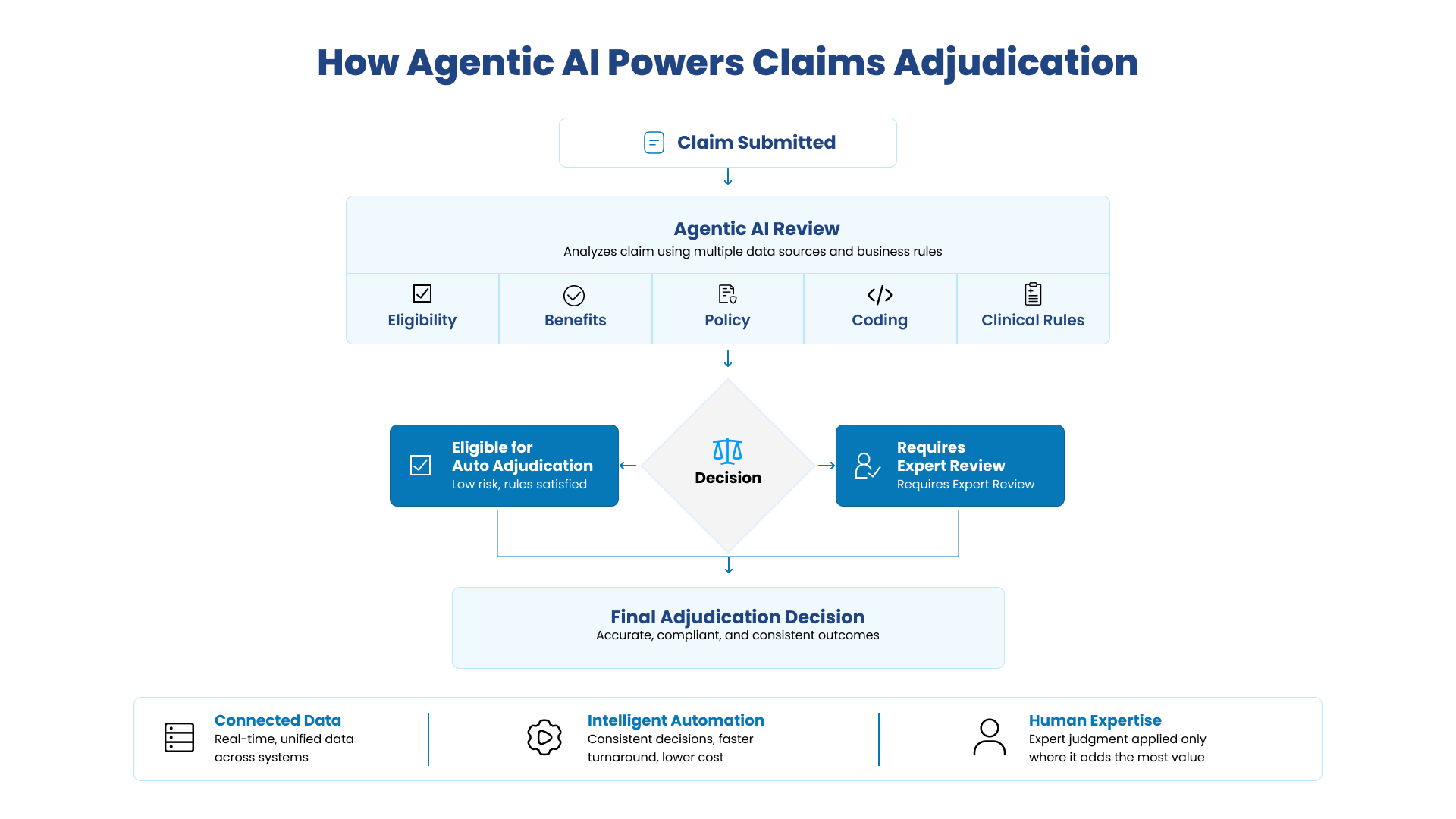
Agentic AI combines intelligent automation with expert review to improve claims adjudication.
The capabilities of agentic AI are ideal for meeting the growing efficiency requirements of claims adjudication processes. Health plans have to process growing claim volumes, and at the same time, navigate ever-evolving regulations, design increasingly personalized benefit packages, and adhere to strict compliance requirements. In addition, they also have to deal with the rising expectations from both providers and members. Traditional automation solutions, such as rule engines and robotic process automation (RPA), are no longer sufficient to address these challenges.
Efficiency gains from deploying agentic AI in healthcare claims adjudication can be immense. Take the case of exceptions. An AI agent can analyze context, learn from previous interactions, and recommend the next best action. Modern agentic AI platforms are built on secure, trust architectures. This means that they ensure the safeguarding of protected health information (PHI) across the claims lifecycle, enabling health plans to comply with HIPAA regulations, be audit ready always, and maintain data integrity at the highest standards. A recent report suggests that healthcare organizations are shifting from isolated AI pilots to enterprise-wide agentic AI adoption, with health plans increasingly prioritizing its use for claims management, utilization management, and prior authorization to improve efficiency, reduce administrative burden, support better operational outcomes, and deliver value-based care (VBC).
7 Best Practices for Modern Claims Adjudication
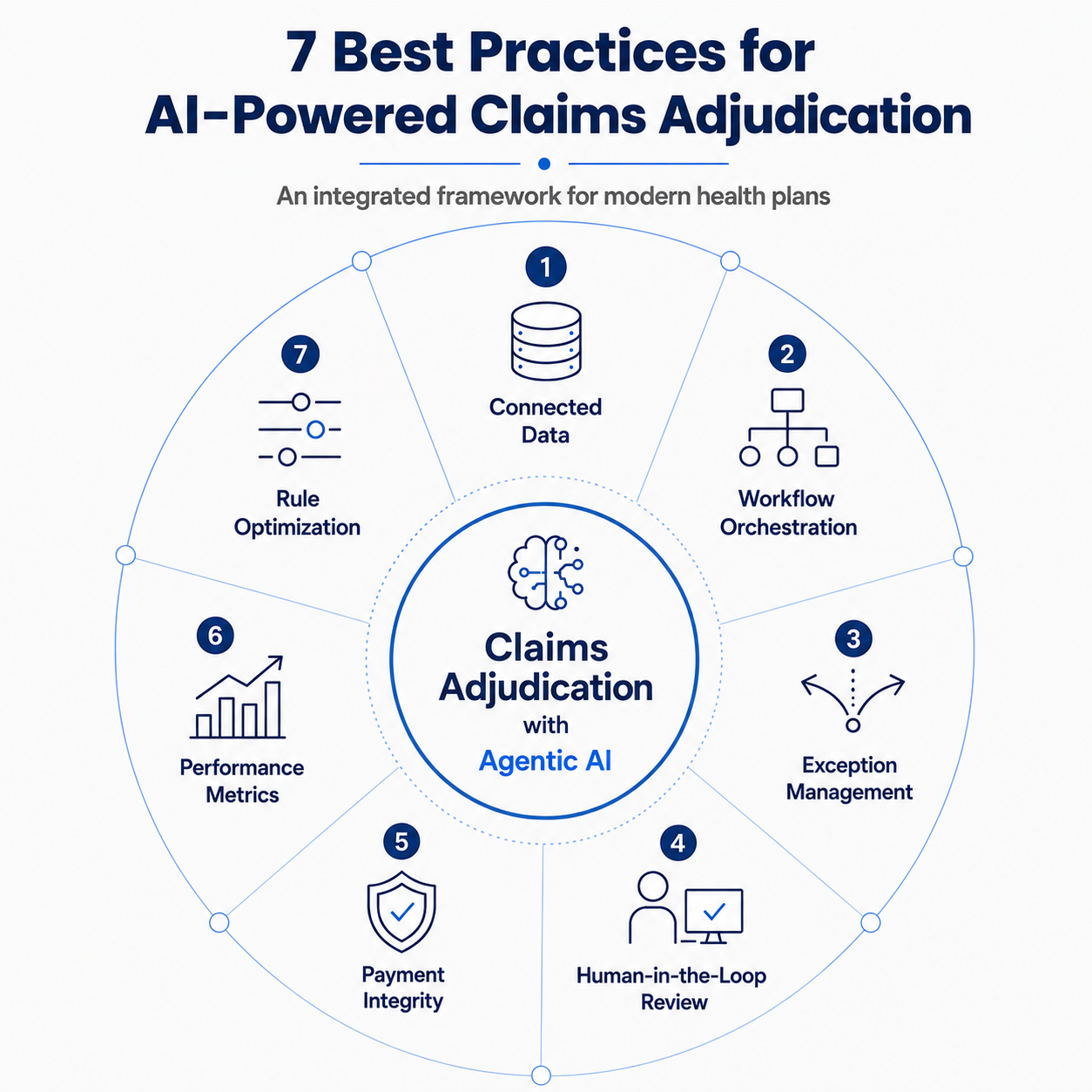
An integrated framework for modern claims adjudication powered by agentic AI.
Claims adjudication today has become more about connecting the right processes, automation, and data intelligence than just speed. Here are some best practices that health plans can implement to boost operational efficiency and stay agile in an increasingly complex healthcare environment:
Build a Unified Data Ecosystem for Claims Processing
Healthcare organizations have to manage huge volumes of sensitive patient data daily. Interconnecting data operations becomes a critical task for them to keep their workflows running smoothly. Once the backend processes are put in place by preset workflows that also include human-in-the-loop review for exceptions, traditional AI automation tools can sufficiently augment them. Agentic AI levels them up even further by making operations more intelligent and autonomous, plugging revenue leakages, enhancing overall efficiency, and empowering you with a key strategic advantage. However, for your AI agents to remain sharp, they need to have uninterrupted access to the necessary information such as claims data, member and provider details, and benefit coverage. If these data points are scattered across different systems, your AI will not be able to operate its full potential. For example, let’s say a member wishes to check on their claim. Unfortunately, your system shows that the member is inactive because their eligibility file is not synced with the enrollment system. This kind of disconnect not only creates confusion for everyone, it increases administrative burden (and, by extension, costs) and diminishes the whole experience for the member. When your data is unified, that mismatch never happens in the first place. Bringing everything together into one connected environment through platforms such as HealthOS will allow your tools to work cohesively as a single unit, extracting complete, accurate, and user-relevant data across stakeholders, leading to faster and far more reliable decisions.
Orchestrate the Entire Claims Lifecycle
Within your claim adjudication lifecycle, automating one step, such as data entry or payment gateway, will deliver small, isolated wins. However, to witness real change, you need to look at the entire claims process as one journey - from start to finish. Rather than fixing just one piece, your aim should be to connect every stage with every other stage. Take payment, for instance. You might have a great tool that calculates payments instantly. But, what if it's still waiting for days for a prior authorization to reach it? The claim sits idle, with the process getting delayed and payment determination remaining stuck. Orchestrating the entire end-to-end pipeline means that authorization arrives well before the payment process begins.
Combine Agentic AI with Human-in-the-Loop Oversight
The design of agentic AI is not to replace claims professionals. On the contrary, its purpose is to make them more effective. The most successful claims adjudication strategies combine intelligent automation with human-in-the-loop oversight, allowing AI agents to process routine, rules-based claims while experienced professionals focus on decisions that require clinical expertise, policy interpretation, or regulatory judgment. Low-risk, straightforward, routine claims can move through the adjudication process with minimal intervention, enabling claims teams to devote more time to high-value exceptions such as medical necessity reviews, complex claims, appeals, high-cost cases, and potential fraud, waste, and abuse (FWA) investigations. By intelligently escalating only the claims that require human review, agentic AI reduces administrative burden, improves operational efficiency. This ensures that health plans maintain the accuracy, compliance, and accountability that modern claims adjudication demands.
Use AI Agents for Intelligent Exception Management
Claims exceptions are unavoidable. However, they don't have to become operation bottlenecks. Traditional automation often comes to a standstill when it encounters missing or inaccurate information, unexpected inputs, or conflicting rules. This leads to claims staying stuck in manual queues until someone resolves the issue. Agentic AI takes a more intelligent approach by identifying why a claim is delayed. For this, it gathers relevant information from connected systems, recommends the next best action, and routes the claim to the appropriate workflow or reviewer. For example, if a claim is missing a diagnosis code or contains some coding discrepancy, an AI agent can detect the issue, analyze similar historical claims by the provider, suggest a likely corrective action, and present the claim again with the necessary context for faster review. This reduces processing delays, minimizes manual effort, and helps health plans resolve exceptions more efficiently while maintaining consistency, accuracy, and compliance.
Continuous Update Business Rules
Healthcare regulations and benefit plans change constantly. Instead of waiting for a periodic review, your AI can help you monitor daily performance, flag recurring bottlenecks, and show you exactly where your rules need to be modified to comply better with the changed regulations. This way, learning and adapting become a natural part of your workflow - not a massive, painful project. With agentic AI, the implementation of these rules across your claims processing system becomes simpler, stays audit-ready, and can essentially run on autopilot.
Strengthen Payment Integrity before Payout
Agentic AI can bolster payment integrity by proactively screening any kind of discrepancy, such as dubious claims, duplicate submissions, and mismatched codes, before the payment is disbursed. Such upfront checks improve payment accuracy and build financial resilience of the organizations. More importantly, these measures save your team’s valuable time and resources that otherwise would have been wasted chasing down wrong payments. A recent development bolsters the urgent need for intelligent claims management. In June 2026, Eli Lilly threatened to pull 340B drug discounts from hospitals that were unwilling or unable to share claims data with the company. The incident has intensified the debate around claims transparency and governance - a clear sign that health plans need AI-powered, autonomous claims processing systems to deal with increasingly complex reimbursement demands.
Track the Key Claims Performance Metrics
Just counting the number of claims processed is not an advisable measure of efficiency and accuracy. What you need to focus on are the core metrics that truly reflect the success of your adjudication system. These could include the satisfaction levels of providers, the frequency of appeals, and costs per claim. The more nuanced ones can include the number of claims getting approved in the first instance and the rate at which exceptions are getting resolved. These metrics give a clear and objective view of whether your people, processes, and AI are genuinely working well together.
From Automation to Autonomy
The future of claims adjudication is not just fully autonomous but also collaborative. More than faster processing, modern healthcare claims management requires connected operations. At the same time, human expertise remains essential for complex medical decisions, regulatory oversight, and policy interpretation. Agentic AI enhances that expertise by eliminating repetitive work, spotlighting relevant information, coordinating workflows, and helping teams make faster, more consistent decisions. Health plans need platforms such as HealthAxis that bring together claims, enrollment, eligibility, provider management, payment integrity, care management, and analytics into a unified operational ecosystem. When these functions work in concert, intelligent automation can deliver greater value across the entire claims lifecycle, aiding the delivery of more empathetic care to those who need it the most.
Frequently Asked Questions
What is agentic AI in healthcare claims adjudication?
In claims adjudication, agentic AI uses intelligent software agents to manage complex, multi-step claims workflows with minimal human intervention. Unlike traditional automation, it can understand context, adapt to changing rules, escalate exceptions for human review, and recommend the next best action.
How does agentic AI improve healthcare claims processing?
Agentic AI helps health plans process claims faster and more accurately by automating routine tasks, analyzing claims in context, identifying coding errors or duplicate submissions, and routing complex cases to the right reviewers. This reduces manual work, shortens adjudication times, improves payment accuracy, and lowers administrative costs.
What are the best practices for modern claims adjudication?
The most effective claims adjudication strategies include building a unified data ecosystem, orchestrating end-to-end workflows, combining agentic AI with human-in-the-loop oversight for intelligent exception management, continuously updating business rules, and monitoring of outcome-based metrics. Together, these best practices help health plans improve claims accuracy, streamline operations, and deliver better experiences for providers and members.
Why is human-in-the-loop review important in AI-powered claims adjudication?
Human-in-the-loop review ensures that AI agents and claims experts work together in tandem. AI handles routine, rules-based claims, while experienced reviewers decide on complex cases that necessitate clinical judgment, policy interpretation, or regulatory oversight. This approach improves accuracy, strengthens compliance, and builds trust in AI-powered claims adjudication.
See HealthAxis in action
Get a personalized walkthrough of HealthOS and the Aipass™ intelligence behind it — mapped to the workflows you run today.