Skip to content
Every patient-physician encounter, be it a simple consultation or a full-fledged surgery, produces clinical information that gets documented into a standardized format. A medical claim turns this information into a standardized reimbursement request that health insurers review and process. These claims are pivotal in not only enabling timely reimbursement and improving member experience, but also in strengthening revenue cycle management (RCM) and regulatory compliance.
What is a Medical Claim?
A medical claim is a request sent by a healthcare provider to an insurance company or government health program to get paid for the care and services provided to a patient. It includes important details about the patient, the treatment received, and the costs involved, helping the insurer review the claim and decide how much to reimburse. To facilitate seamless processing and prevent denials, a typical claim meticulously documents several critical elements: the patient's full demographic and eligibility details, the provider's accredited credentials and National Provider Identifier (NPI), the relevant diagnosis and procedure codes, and the exact dates and places of the treatment rendered.
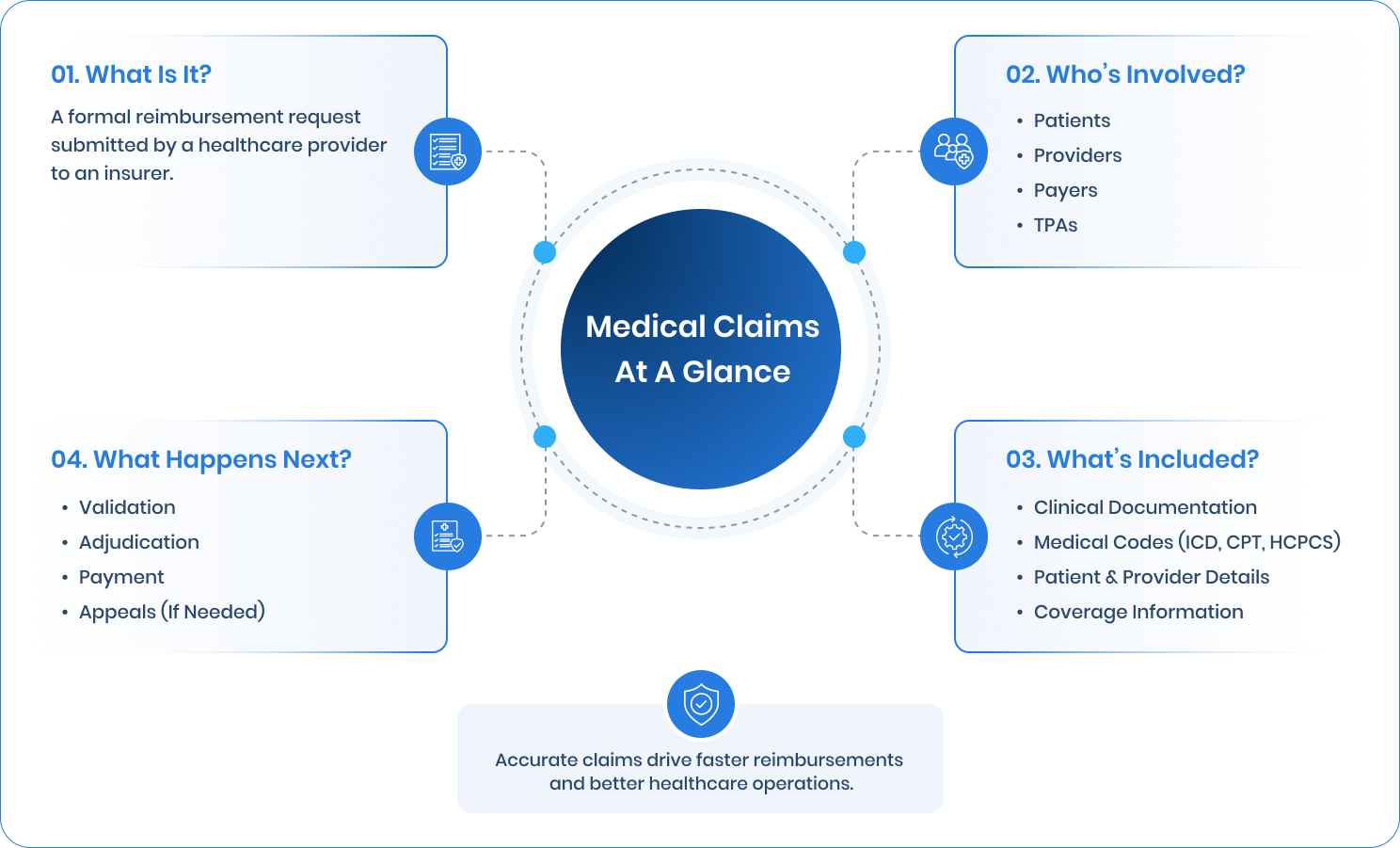
The components of a medical claim.
Once a claim is submitted, it undergoes a thorough review process. During this review, the insurer scrutinizes the submitted data with a fine-toothed comb to verify coverage under the patient's specific health plan, assess medical necessity, and determine the reimbursement amount owed to the provider.
What is Medical Claims Management?
Claims management is the real-world practice of coordinating people, processes, technology, and financial resources to ensure claims are processed accurately and efficiently. Lying at the heart of this ecosystem are the key stakeholders - the patients, the providers (physicians, hospitals, clinics, and other healthcare facilities), and the payers (insurance companies). While patients supply foundational information, healthcare providers create the necessary documentation after care has been administered to the patient. These documents are then submitted to the payers for reimbursement. On the other hand, health insurers or payers evaluate submitted claims and adjudicate them.
Complementing this trio are third-party administrators (TPAs) who perform claims processing and related administrative functions on behalf of insurers. The best claims management practices harmonize compliance, fiscal, and operational requirements of every participant across the entire claims lifecycle. When implemented effectively, these practices eliminate friction at each touchpoint, minimize resource wastage, maintain (and even accelerate revenue cycles), and reduce the risk of costly denials.
Understanding the Medical Claims Lifecycle
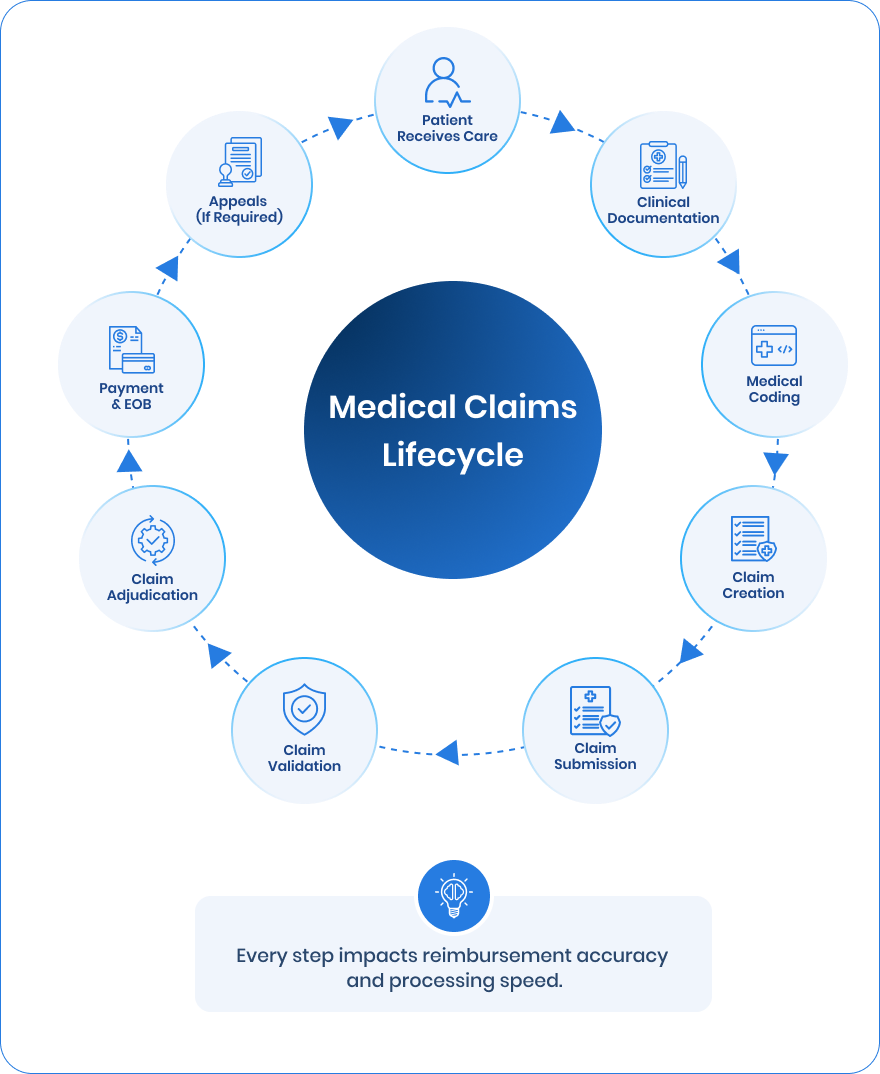
The chronology of a medical claim.
The general lifecycle of a medical claim follows a series of steps, although these may vary across organizations. Here’s how the journey of a claim unfolds:
1. Care reception
The first step of the lifecycle commences once a patient receives medical services from a provider. The care so received typically covers consultations, diagnostic procedures, surgeries, emergency care or treatment, laboratory testing, and preventive health services.
2. Clinical documentation
Healthcare professionals document every step of the patient's medical journey, right from their first interaction regarding symptoms to the final physician notes in terms of the diagnosis and the recommended treatment. The more complete and accurate the documentation, the stronger the claim and the lesser its chance of getting denied.
3. Coding
Insurers need to unambiguously interpret the services rendered, regardless of who the provider is. For this, certified medical coders convert clinical documentation into:
- ICD-10 codes for diagnoses
- CPT codes for physician services and procedures
- HCPCS codes for medical equipment, supplies, and additional healthcare services
4. Claim creation
Using the encoded information, providers prepare the medical claim, which contains administrative details such as the insurance coverage of the patient and service dates. Most healthcare organizations use electronic health record (EHR) systems and claims management software to generate claims automatically.
5. Claim submission
Once prepared, the provider electronically submits the claim to the payer, typically through a healthcare clearinghouse, which performs basic validation checks to identify formatting errors or missing information.
6. Claim validation
Here, the payer verifies the submitted claim to ascertain if it contains the required information related to provider credentials, documentation, coding accuracy, and coverage, among others. Claims that fail these checks are likely to be rejected before the adjudication process even begins.
7. Claim adjudication
If a claim passes initial verification, it enters what is probably the most critical stage: adjudication. This is the stage where the payer thoroughly and comprehensively reviews the submitted claim and determines reimbursement. Based on these evaluations, the claim may be approved fully, partially, or denied entirely. Oftentimes, before making a decision, the insurer can also request for some additional information from the provider for better clarity.
8. Payment determination and explanation of benefits (EOB)
After completing adjudication, the payer issues payment according to the patient's insurance coverage and provider contract. Simultaneously, an explanation of benefits (EOB) is generated for the patient that summarizes the:
- Total charges levied by the provider
- Services provided
- Coverage scope of the patient’s insurance
- Payment to be made by the patient
In addition, providers also receive an electronic remittance advice (ERA) that contains detailed payment information and claim adjustments.
9. Appeals and corrections
More often than not, claims require corrections due to issues such as coding errors, missing documentation, and medical necessity. Providers review denied claims, make corrections, prepare and submit supporting documentation, and can formally appeal the payer's decision.
Types of Medical Claims
There are several ways in which medical claims can be categorized depending on the service provided, the type of provider submitting the claim, and the method of submission. The most common grouping of claims can be done in the following manner:
Professional Claims
These claims are initiated by individual healthcare practitioners or outpatient facilities for a variety of services such as physician consultations, preventive care, diagnostic testing, and minor procedures. In the United States, professional claims are commonly submitted using the CMS-1500 form.
Institutional Claims
Claims of this nature are submitted by hospitals, nursing facilities, rehabilitation centers, and other institutional providers. Typically submitted using the UB-04 (CMS-1450) claim form, these generally involve inpatient stays, emergency room (ER) visits, surgeries, and other facility-based services.
Pharmacy Claims
Pharmacy claims are prescription claims submitted by pharmacies to the insurer or pharmacy benefit manager (PBM) of the patient for reimbursement.
Electronic and Paper Claims
Most healthcare organizations now submit claims electronically through healthcare clearinghouses. Electronic claims reduce manual data entry burden, improve processing speed, and minimize errors. Paper claims continue to be used in limited circumstances, particularly when electronic submission is unavailable or specific payer requirements apply.
Original Claims
Original claims are the reimbursement requests submitted for the first time after healthcare services are provided.
Corrected Claims
Corrected claims replace original claims when coding errors, missing information, or billing inaccuracies are identified and rectified.
Appeal Claims
These claims are made by providers to dispute a payer's adjudication decision and request a formal review supported by additional documentation.
Such categorization helps healthcare organizations process claims accurately and efficiently.
Common Challenges in Medical Claims Management
In today’s digital age, medical claims management has grown into a highly complex administrative function. Involvement of multiple stakeholders, evolving payer policies, exponentially increasing data volumes, and tightening regulatory requirements have together created a challenging environment for healthcare organizations. So, what kind of difficulties do insurance companies most frequently encounter when processing claims?
Incomplete or Inaccurate Documentation
The success of a medical claim hinges entirely on complete and accurate clinical documentation. Missing or faulty physician notes, inaccurate patient information, incomplete treatment records, coding errors, or any other discrepancy in documentation often lead to delays or denials, hindering the claim lifecycle and disrupting the insurer’s revenue management system.
Coding Errors
One of the leading reasons for claim denials is incorrect coding under the ICD-10, CPT, and HCPCS sets. The smallest coding inaccuracy can result in reimbursement delays, payment reductions, requests for additional documentation, or flat-out denial.
Eligibility and Coverage Verification
The likelihood of a claim getting denied rises when there are changes in patient eligibility or insurance coverage before services are rendered. In such cases, verifying the benefits before accessing treatment becomes important since it lowers the possibility of claim rework and improves reimbursement timelines.
Prior Authorization Requirements
A growing number of healthcare services require prior authorization from insurers. If this authorization is missing or does not match the services provided, payers may deny or only partially reimburse the claim amount. The current process has gained notoriety for creating avoidable delays for patients and burdening providers with unnecessary paperwork. This, in turn, has led to an erosion of trust between payers and healthcare providers.
Claim Denials and Rework
When a claim is denied, providers need to investigate the reason for denial, gather additional documentation, correct errors, and resubmit claims, which increases their administrative expenses.
Changing Regulatory Requirements
With evolving public health challenges and frequent regulatory updates, healthcare organizations are operating in an increasingly complex compliance environment. Keeping pace with federal and state regulations, reimbursement policies, interoperability mandates, and privacy and security standards has become a persistent challenge. As a result, insurers and providers need to equip themselves with AI-powered intelligent solutions to optimize their claims management processes to maintain compliance, reduce administrative risk, and ensure timely reimbursement.
Manual Workflows and Legacy Systems
Manual workflows and legacy systems are known to create unnecessary friction in claims processing. Repetitive data entry, disconnected systems, and multiple handoffs slow down operations, increase the risk of errors, and make it difficult to track claims across their lifecycle. AI-powered claims management solutions address these challenges by automating routine tasks, unifying data, and intelligently routing exceptions for human-in-the-loop review. This allows insurers and providers to accelerate claims processing, improve operational efficiency, and focus human expertise where it delivers the greatest value.
The Future of Claims Management
The constant presence of uncertainties in the world today has nearly guaranteed that claim volumes continue to grow in the forthcoming years, with payer requirements evolving alongside. Such a dynamic landscape has made modernizing medical claims processing a strategic imperative. Healthcare organizations will need to accelerate the adoption and integration of AI-powered claims management tools to streamline workflows, reduce administrative burden, and ensure compliance. For example, solutions that are embedded with intelligent document processing (IDP) tools not only improve efficiency but also keep patient data safe and address issues related to interoperability. Similarly, AI-native platforms can enable organizations to achieve these goals while also helping them build operational resilience. HealthAxis, for instance, is now armed with nventr capabilities that have made the platform smoother and even more seamless - exactly what the ever-changing needs of the healthcare industry require to keep sensitive data safe and secure.
Frequently Asked Questions
What is a medical claim?
A medical claim is a formal request submitted by a healthcare provider - such as a physician or a hospital - to a health insurance company or payer for reimbursement of services provided to a patient.
What is medical claims management?
Medical claims management is the real-world practice of coordinating the key stakeholders - patients, providers, insurers, and TPAs - and the various stages of a medical claim throughout its lifecycle.
What information does a medical claim contain?
A medical claim contains detailed clinical, administrative, and financial information shared by a provider through a formal documentation process with the payer. The payer then uses this information to verify coverage, check eligibility, and determine the payment amount to a provider.
How does the medical claims process work?
The medical claims lifecycle typically begins with clinical documentation. The next stages usually follow this chronology: medical coding, claim creation, submission, validation, adjudication, payment determination, and, if necessary, appeals or corrections.
Why are medical claims denied?
Medical claims may be denied because of coding errors, incomplete documentation, eligibility issues, missing prior authorization, duplicate submissions, or services that are not covered under the patient's health plan. Accurate documentation and coding play the most critical role in minimizing the possibility of a claim getting denied.
How can technology improve medical claims management?
Modern technologies such as AI-powered claims management platforms, intelligent document processing, and workflow automation aided by agentic AI can enable healthcare organizations to reduce manual workload, improve claims accuracy, speed up adjudication, and strengthen compliance across the claims lifecycle.
See HealthAxis in action
Get a personalized walkthrough of HealthOS and the Aipass™ intelligence behind it — mapped to the workflows you run today.