Skip to content
The process of creating a medical claim opens multiple opportunities for unscrupulous activities, giving rise to what is commonly known as fraud, waste, and abuse (FWA) in healthcare. As healthcare operations have grown in complexity and volume, these opportunities have multiplied in more ways than one.
Critically, FWA has become a persistent financial challenge that costs the healthcare industry billions of dollars each year. The National Health Care Anti-Fraud Association (NHCAA) estimates that the financial losses due to health care fraud are in the tens of billions of dollars each year. While a conservative estimate has been set at 3% of total health care expenditures, some government and law enforcement agencies place the loss as high as 10% of the annual health outlay, which could mean more than $300 billion. Understanding FWA is the first step toward protecting healthcare resources and improving payment integrity.
What Is Fraud, Waste, and Abuse in Healthcare?
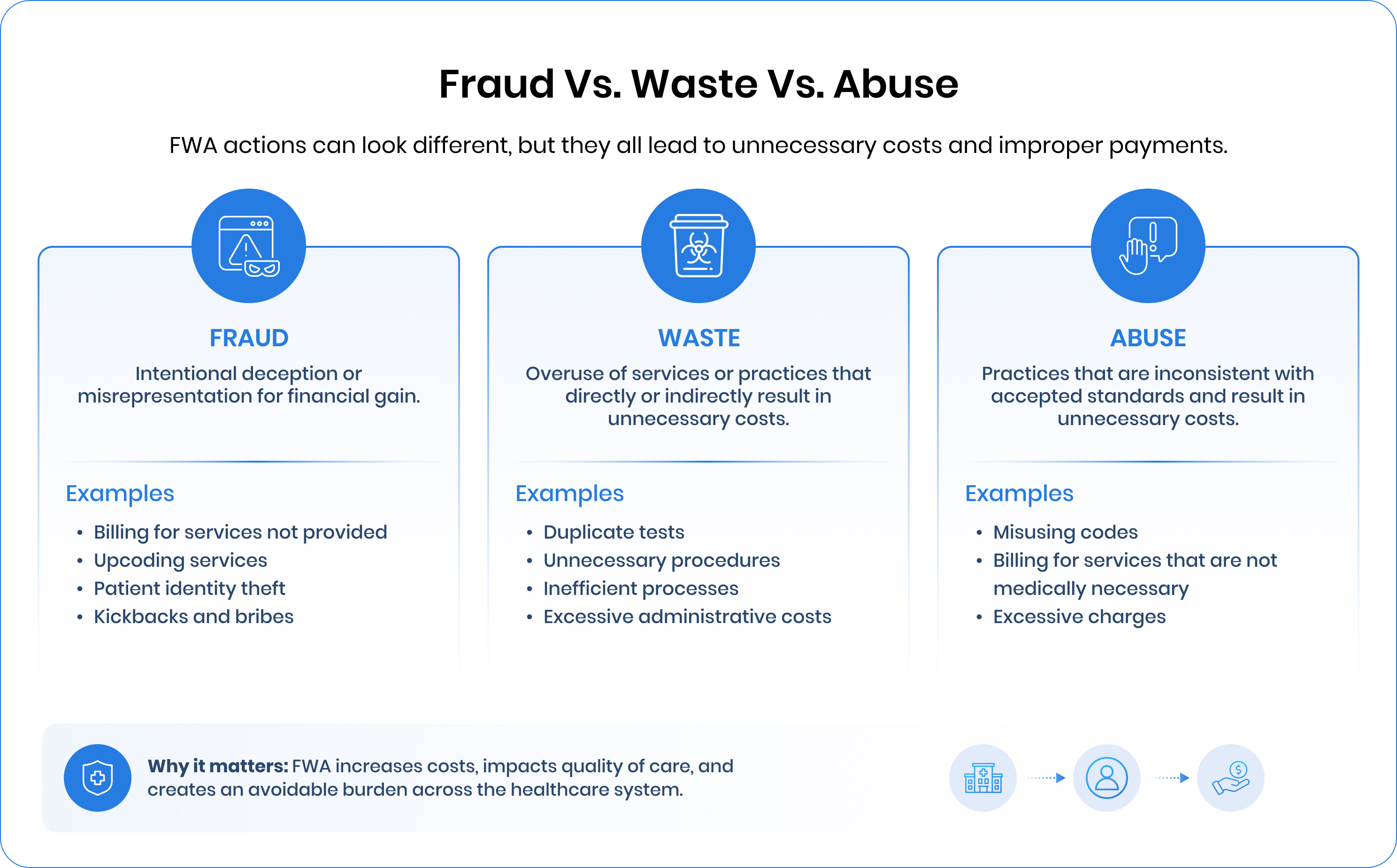
Fraud, waste, and abuse is a collective term that refers to activities that result in unnecessary and avoidable healthcare spending, improper payments to providers, and misuse of healthcare resources. What distinguishes these terms from each other is one critical factor: intent.
Fraud
The Centers for Medicare & Medicaid Services (CMS) defines fraud as “knowingly and willfully executing, or attempting to execute, a scheme or artifice to defraud any health care benefit program or to obtain, by means of false or fraudulent pretenses, representations, or promises, any of the money or property owned by, or under the custody or control of, any health care benefit program.” In other words, fraud is the intentional misrepresentation of information to obtain an unauthorized payment or benefit. The Health Care Fraud Statute treats it as a criminal offense, punishable by imprisonment up to 10 years and may incur fines of up to $250,000.
Some common examples of healthcare fraud include:
- Phantom billing: knowingly billing for services not furnished or supplies not provided.
- Upcoding: billing for more expensive services than the ones rendered.
- Billing for nonexistent prescriptions.
- Falsifying patient diagnoses or medical records.
- Billing for procedures that have no medical necessity.
- Offering or accepting illegal kickbacks in exchange for patient referrals.
Waste
According to CMS, waste “includes practices that, directly or indirectly, result in unnecessary costs to the Medicare Program, such as overusing services.” Unlike fraud, waste is usually not considered criminal as it is generally not intentional - it is seen as the overuse, misuse, or inefficient use of healthcare resources that results in unnecessary costs.
Examples of healthcare waste include:
- Conducting excessive office visits or writing excessive prescriptions.
- Ordering excessive laboratory tests.
- Overprescribing medications for treating a specific condition.
- Repeating procedures due to incomplete or unavailable information.
- Maintaining inefficient administrative processes that increase operational costs.
Even though waste is not a criminal violation, it exerts significant financial and operational strain on health plans and government healthcare programs.
Abuse
On the other hand, abuse is understood as an act that “involves paying for items or services when there is no legal entitlement to that payment, and the provider has not knowingly or intentionally misrepresented facts to obtain payment.” CMS states that abuse cannot be categorically differentiated from fraud because “the distinction between fraud and abuse depends on specific facts and circumstances, intent and prior knowledge, and available evidence, among other factors.”
Examples of actions that may constitute healthcare abuse include unknowingly:
- Billing for brand name drugs when generics are dispensed.
- misusing medical codes on a claim, such as unbundling codes
- billing for unnecessary medical services
- excessively charging for services or supplies
Although these terms are often grouped together, they represent a wide array of improper activities that produce the same outcomes - higher healthcare costs, increased administrative burden, delayed payments, and trust erosion in the healthcare ecosystem.
The Growing Impact of FWA in Healthcare
Healthcare fraud, waste, and abuse divert resources away from those who need medical care the most. One study estimated that waste-related costs in the U.S. healthcare system from 2012 to 2019 ranged from $760 billion to $935 billion, accounting for approximately 25% of total healthcare spending. Another estimate released by the U.S. Government Accountability Office (GAO) revealed that between 2003 and 2021, cumulatively, improper payments stood well over $2 trillion. Widening prevalence of chronic conditions, soaring healthcare costs, increasingly complex reimbursement models, growing claim volumes, and expanding regulatory oversight have opened more avenues for FWA.
Even more startling is the fact that healthcare fraud is not only increasing in frequency but also in scale. In March 2026, Aetna agreed to pay $117.7 million after the Department of Justice (DOJ) accused it of submitting incorrect diagnoses for its MA members in order to increase its risk adjustment payments, violating the False Claims Act. Another such instance came to light in January 2026 when health plan affiliates of one of the top healthcare organizations agreed to pay the U.S. government upwards of $500 million to settle allegations of inflating the sickness of Medicare Advantage (MA) enrollees to accrue higher reimbursements from the government.
The pressure on health plans and government agencies to identify these violations and prevent them is immense. The Office of Inspector General (OIG), the watchdog of the Department of Health and Human Services (HHS), announced in July 2026 that it is cracking down on Medicaid and MA frauds. According to the OIG, it has generated $5.56 billion in expected recoveries and projected savings over a six-month period and it has barred over 1,200 individuals and companies from federal programs. Such preemptive measures reflect a definitive and deliberate shift towards the institutional adoption of pre-payment strategies to catch FWA. This is where AI enters the picture.
How AI Is Transforming FWA Detection in Healthcare
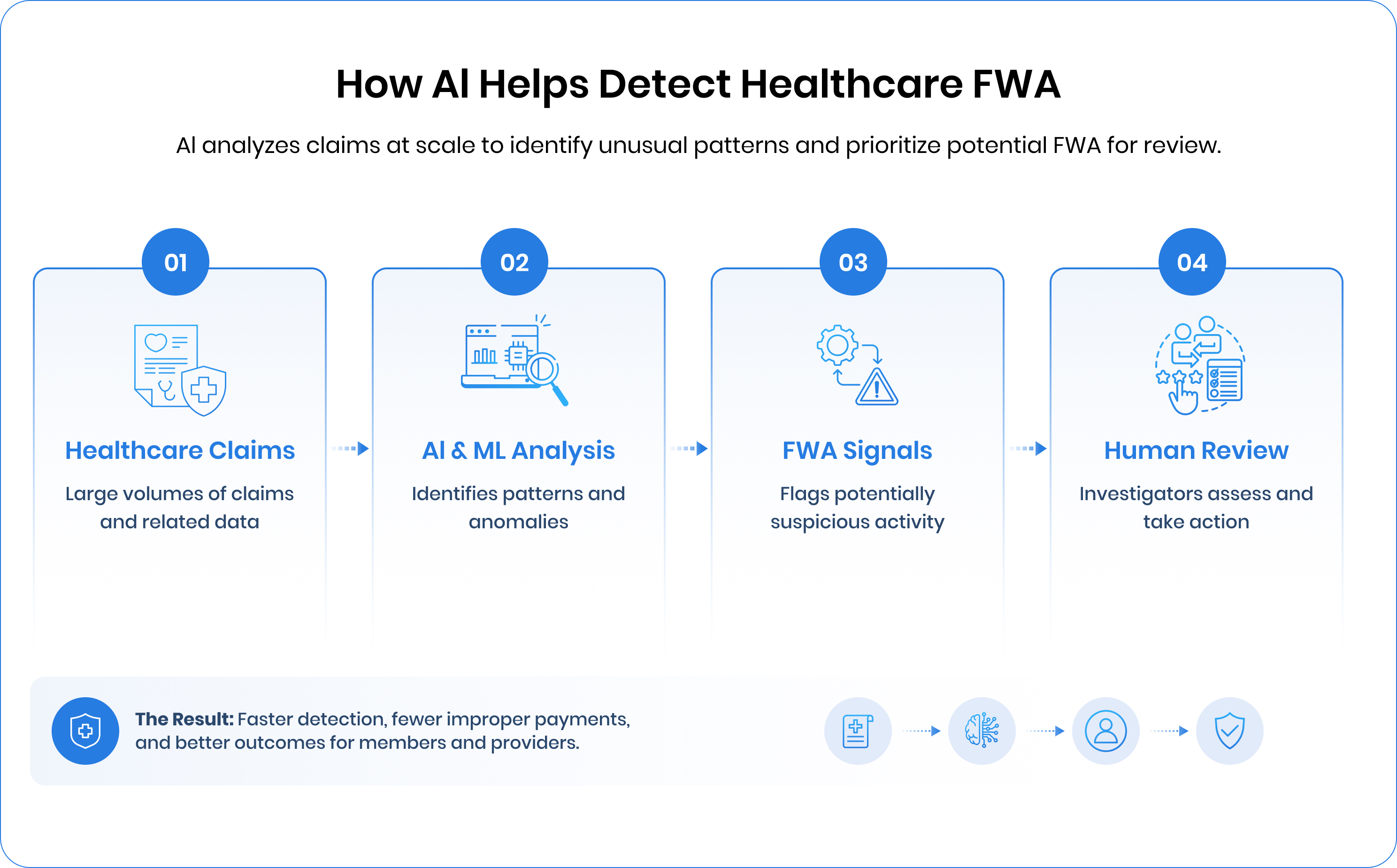
The digitization of healthcare claims operations has led to an asymmetric increase in the sophistication with which fraud, waste, and abuse activities are being conducted. Although healthcare organizations have conventional security measures in place, such as biometrics and one-time password (OTP), they need a much stronger arsenal to prevent modern-day FWA activities. This is where artificial intelligence (AI), machine learning (ML), and advanced analytics can play a vital role in ensuring payment integrity and reimbursement accuracy. For example, AI agents can detect outliers and patterns that traditional methods may have missed, while ML and predictive modeling can pinpoint FWA scenarios that are likely to emerge.
Leading healthcare tech companies are deploying advanced AI capabilities. For example, HealthOS, HealthAxis’s enterprise healthcare operating system (EHOS) for meeting every demand of a modern healthcare system, with intelligence embedded throughout. The platform consists of six connected workspaces powered by Aipass™, the intelligence engine that connects claims administration, member eligibility, authorizations, benefits, and care coordination. Of these six, one module is dedicated entirely to detecting and preventing fraud, waste, and abuse, and once detected, the activity is then flagged and routed to the relevant authorities - all the while adhering to human-in-the-loop (HITL) practices. Such solutions are also gaining momentum at the governmental level. In February 2026, the HHS issued a Request for Information (RFI) seeking inputs on how AI tools can be implemented to enhance the capabilities of CMS to prevent, detect, and respond to FWA in Medicare, Medicaid, the Children’s Health Insurance Program (CHIP), and the Health Insurance Marketplace.
Building a More Proactive FWA Strategy
Health plans can no longer afford to mitigate the damage done by fraud, waste, and abuse after the money has left the system. The stakes today are higher than ever - widening prevalence of chronic conditions, an aging population, and debilitating socioeconomic conditions have all necessitated the institutionalization of value-based, empathetic care to those who need it most. AI is enabling this transition by identifying behavioral anomalies, analyzing claims continuously, and surfacing high-risk payment activity. But, technology alone is not enough. FWA prevention strategies will require a highly calibrated and coordinated approach that unifies AI with robust controls, domain expertise, and most of all, human judgment.
Frequently Asked Questions
1. What is fraud, waste, and abuse (FWA) in healthcare?
FWA is the improper use of healthcare services or funds that can lead to incorrect claims payments, compromising payment integrity. Fraud is intentional deception, while waste is the unnecessary or inefficient use of resources. Abuse is a set of acts that involves paying for items or services when there is no legal entitlement to that payment, which may not be intentional.
2. What are common examples of healthcare FWA?
Common examples of FWA include upcoding, phantom billing, duplicate or unnecessary services, inaccurate diagnoses, improper use of billing codes, excessive prescribing, and fraudulent risk adjustment claims.
3. How can health plans detect and prevent fraud, waste, and abuse?
Health plans can combine pre-payment strategies, claims analytics, provider monitoring, audits, and targeted investigations to identify potential FWA. AI and machine learning can strengthen these efforts by detecting unusual patterns across large volumes of claims and prioritizing higher-risk activity for human review.
4. How is AI changing healthcare fraud detection?
AI enables health plans to move beyond simple compliance and fixed rules toward continuous, risk-based monitoring. AI-powered solutions can analyze claims and related data at scale, spot and surface anomalies, and detect emerging patterns, helping investigators focus on the cases most likely to require attention - while maintaining human oversight in the decision-making process.
See HealthAxis in action
Get a personalized walkthrough of HealthOS and the Aipass™ intelligence behind it — mapped to the workflows you run today.