Skip to content
Processing healthcare claims is inherently complex, and maintaining payment accuracy of each claim even more so. The smallest of mistakes can result in over or underpayments, delayed reimbursements, unfair claim denials, and unnecessary administrative work. The FY 2025 Improper Payments factsheet of the Centers for Medicare and Medicaid Services (CMS) shows that the national Medicare Fee-for-Service (FFS) improper payment rate is 6.55%, or $28.83 billion. That’s why payment integrity holds much significance in the health plan operations.
Traditional approaches have been designed to be mainly reactive - focusing on correcting wrongs after detecting errors. Modern payment integrity solutions focus on ensuring every payment is accurate the first time, supported by data, AI-powered analytics and intelligent automation, clinical know-how, and adaptive business rules to ensure accuracy across the entire payment cycle. With health plans having to juggle soaring claim volumes, deliver value-based care, and navigate ever-changing regulations all at the same time, payment integrity has become a core strategic asset.
What is Payment Integrity in Healthcare?
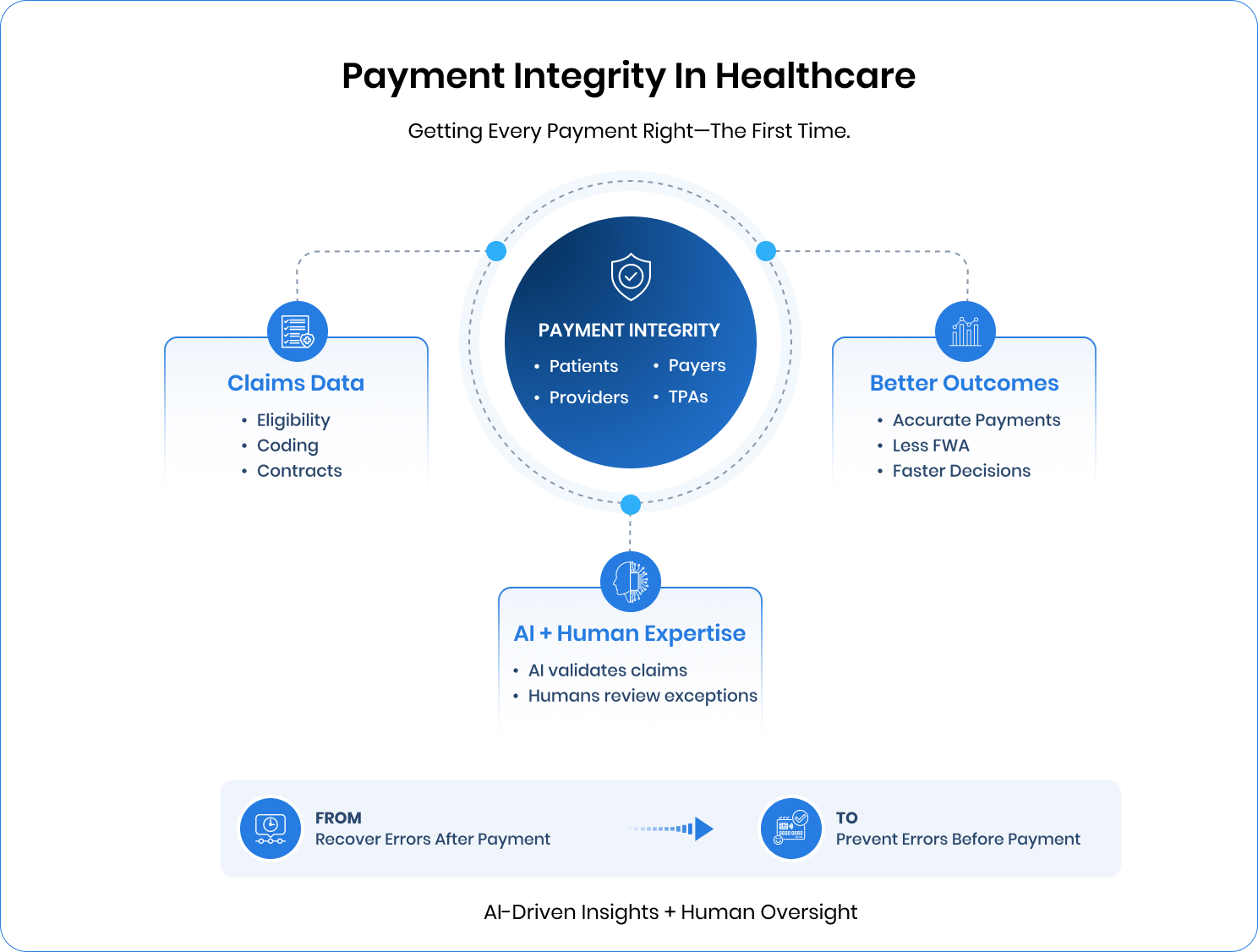
Payment integrity in healthcare is the process of ensuring healthcare claims are paid accurately, and according to contractual, clinical, and regulatory requirements. The objective is straightforward: the right payment, to the right provider, for the right service, at the right time.
To achieve this, payment integrity programs perform multidimensional evaluations of every claim. These typically include an in-depth scrutiny of:
- Member eligibility and benefits
- Medical coding accuracy
- Provider contracts
- Medical necessity
- Coordination of benefits
- Fraud, waste, and abuse (FWA)
Payment integrity is often associated with detecting overpayments after claims have been processed. However, today's leading health plans increasingly emphasize preventing payment errors before money leaves the organization. Agentic AI assistants such as NOVA enable this shift by autonomously evaluating clinical evidence, coding patterns, and claims data in context before payment decisions are made. These intelligent assistants combine AI capabilities with human-in-the-loop review and help health plans validate claims more accurately, reduce unnecessary appeals, and adapt with increasingly dynamic operational workflows.
Why Payment Integrity is Important for Government Programs and Health Plans
Health plans wrestle with the same fundamental issue: paying claims accurately within an intricate healthcare ecosystem. This holds true whether you are serving commercial members or administering Medicare and Medicaid programs. For government programs, the stakes are even higher because they are managing public money, where every dollar demands full accountability and meticulous compliance with federal and state regulations. This level of stewardship requires minimizing erroneous payments as they not only increase financial waste but also erode public confidence. Recent estimates reveal that Medicare fraud costs over $60 billion every year. To prevent such losses, in May 2026, the House Ways and Means Committee introduced the Medicare Payment Integrity Enhancement Act. Under the new legislation CMS can authorize the Recovery Audit Contractors (RACs) to conduct pre-payment claim reviews to identify fraudulent claims prior to payment.
More broadly, payment integrity produces benefits that extend beyond cost savings. It sharpens payment precision, slashes improper payment rates, deepens compliance, reduces provider disputes, accelerates processing, lightens administrative loads, and leads to fewer billing hiccups. As reimbursement models pivot toward value-based care, payment accuracy gains even greater importance. Traditional FFS claims remain complex, while newer reimbursement arrangements have introduced additional contractual and reconciliation requirements. This expanding complexity has made the building of strong payment integrity capabilities more urgent than ever.
How Payment Integrity Services Can Address Fraud, Waste, and Abuse (FWA) with AI
Fraud, waste, and abuse are among the leading causes of improper healthcare payments. While fraud involves intentional deception, waste is a direct result of inefficient practices. Abuse occurs when services are billed or provided in ways that are inconsistent with accepted standards. With AI-powered tools and solutions, payment integrity services can overcome the challenges of increased costs and administrative burdens created by FWA.
AI-Powered Early FWA Detection
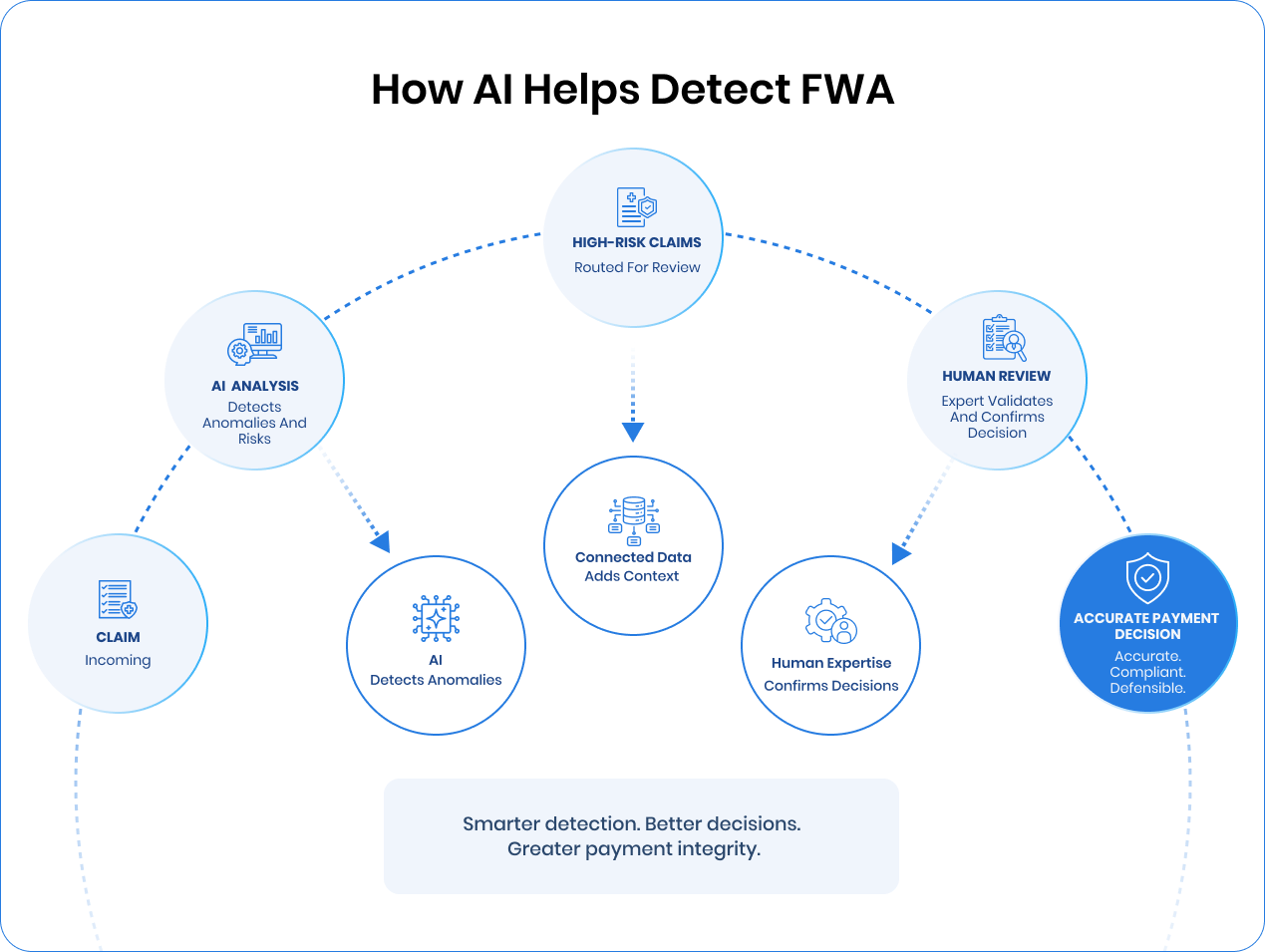
Modern payment integrity strategies deploy AI to analyze claims, clinical documentation, and billing patterns at scale. For example, in May 2026, the U.S. Department of Health and Human Services (HHS) announced the Audit Enforcement and Risk Oversight (AERO) program that will use AI technology to detect fraud through records across all 50 US states. Intelligent automation can further strengthen health plan administration by identifying unusual coding, duplicate claims, or suspicious behavior patterns, detecting potential FWA earlier, and prioritizing high-risk claims for human-in-the-loop review.
Connect Data to Sharpen Payment Decisions
Complexity in claims processing increases with continuous data input and evolving validation and timing requirements. In such an environment, detecting FWA becomes all the more difficult especially when claims, provider, and clinical data are located in separate or isolated systems. Bringing these data sources together provides a complete view of each claim, helping organizations identify and remove inconsistencies, improve payment accuracy, and uncover emerging trends that may otherwise be missed. Here, agentic AI can prove instrumental in processing claims faster, and cross-referencing claims, medical records, and pricing to flag anomalies and assess risk score.
Bolster the Process with Human Expertise
With AI capabilities becoming ubiquitous across claims management, the question of how they can be employed responsibly is gaining much attention. The answer to this question lies in adopting a human-in-the-loop (HITL) approach that combines AI with expert oversight. More specifically, human reviewers validate AI-generated decisions, catch errors, identify bias, and ensure decisions remain accurate, transparent, and adaptable when needed. In high-stakes operations such as underwriting and managing sensitive health data, HITL assumes a central position and becomes a trust multiplier for stakeholders.
Making Payments Smarter and More Accurate
As healthcare reimbursement grows more complex, payment integrity in healthcare has transformed from being a mundane back-office process into a strategic imperative. Health plans are actively moving away from post-payment recoveries of improper payments and adopting a more preventive approach using agentic AI, intelligent automation, and data-driven decision-making. The goals of these technologies are clear: improve claims payment accuracy, identify risks sooner, and streamline payment decisions at scale. However, technology alone is not enough. Human expertise is instrumental in handling exceptions, evaluating complex claims, interpreting regulations, and ensuring accuracy, transparency, and defensibility of payment decisions. This is exactly what AI-native platforms such as HealthAxis deliver - helping healthcare organizations to overcome modern payment integrity challenges by streamlining operations, building smarter workflows, and fostering confidence across the claims lifecycle.
Frequently Asked Questions
What is payment integrity in healthcare?
Payment integrity in healthcare refers to the process of ensuring healthcare claims are paid accurately and in compliance with clinical, contractual, and regulatory requirements.
Why is payment integrity important for health plans?
Payment integrity aids health plans in reducing improper payments, strengthening compliance, improving claims payment accuracy, and lowering administrative costs. It also minimizes the possibility of disputes between payers and providers and builds financial resilience in fee-for-service as well as value-based care models.
How does AI improve payment integrity?
AI, particularly agentic AI, improves payment integrity by autonomously analyzing claims, clinical documentation, and billing patterns to identify coding errors, duplicate claims, and potential fraud, waste, and abuse (FWA). Combined with human oversight, AI-powered solutions enable faster, more accurate, and more consistent payment decisions.
How do payment integrity services reduce fraud, waste, and abuse?
Payment integrity services use AI, data analytics, and clinical review to detect suspicious billing patterns, duplicate claims, coding inconsistencies, and other payment anomalies. This helps health plans detect fraudulent patterns, identify behavior changes, reduce financial waste, and lower the chances of abuse.
See HealthAxis in action
Get a personalized walkthrough of HealthOS and the Aipass™ intelligence behind it — mapped to the workflows you run today.