Skip to content
You’ve probably heard the term prior authorization (PA) whenever you have been required to undergo any type of medical procedure, such as a surgery or an MRI scan, or have needed a prescription for an expensive medication. Prior authorization is the process wherein your provider needs to get approval from your health plan before you can access a medical treatment or procedure. The process is quite common and widespread: data from the Centers for Medicare and Medicaid Services (CMS) show that in 2024 alone around 53 million prior authorization requests were submitted on behalf of Medicare Advantage (MA) enrollees by MA insurance companies. For virtually all MA enrollees, prior authorization is mandatory for availing higher-cost services, such as chemotherapy and inpatient hospital stays.
The need for prior authorization can arise for anyone at any point of time, so it is worth understanding what the process is, how it works, and why it exists — and where prior authorization software and AI-powered prior authorization tools are starting to change how quickly that process moves.
What is Prior Authorization?
If you’re searching for a quick answer on prior authorization meaning: it refers to the approval that a medical provider must receive from a health plan to render a complex or expensive service, treatment, or prescription, if it is not an emergency. It is essentially a cost-control mechanism that is used to determine whether a patient qualifies for a specific service or medication before obtaining it. Although prior authorization does not guarantee payment, submitting the necessary documentation for it increases the likelihood of your health plan covering the cost. Some other commonly used terms for prior authorization include preauthorization, prior approval, and precertification. If you are a patient requiring a complex or expensive medical service, initiating the prior authorization process early is critical; otherwise your health plan may not pay for it, and you could end up with a significant expense.
When is Prior Authorization Needed?
For health insurance companies, prior authorization is the route through which they can review a service, procedure, item, or medication to confirm its medical necessity. Common scenarios where the prior authorization process is triggered include:
- A planned surgery
- Admission to a hospital or a skilled nursing facility (SNF)
- Procedures requiring critical medical equipment such as an IV infusion pump or a portable oxygen tank
- Conditions that necessitate the use of MRI or CT scans
Prior authorization may also be required when medications:
- are expensive
- have serious side effects
- can be harmful when consumed in combination with other drugs
- have the potential for abuse
What Is the Prior Authorization Process?
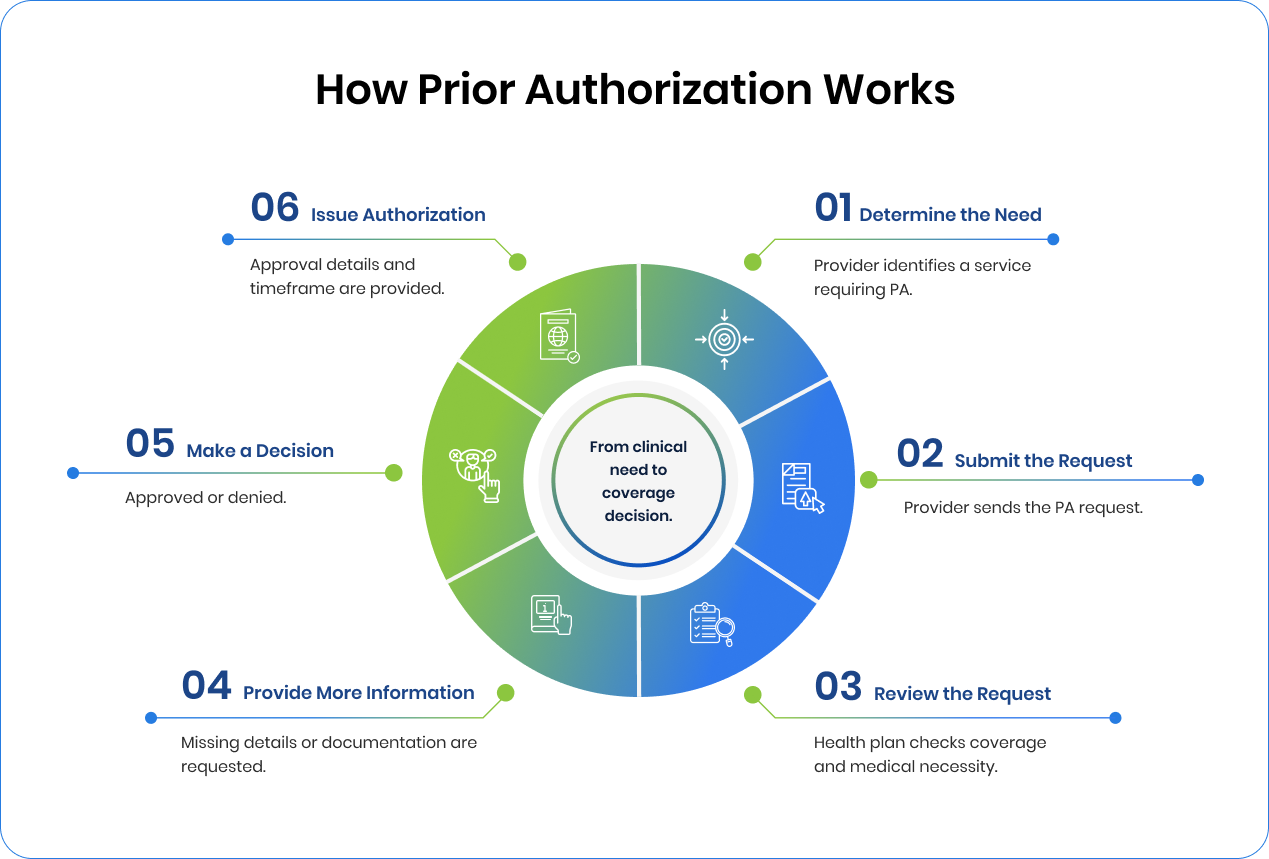
The prior authorization process consists of a series of short but important steps that your doctor’s office is entirely responsible for.
Step 1
The physician decides on the medical necessity of a procedure, medication, or equipment.
Step 2
The physician then contacts the payer (insurance company) and formally submits the PA request, complete with the necessary ICD-10, CPT, and HCPCS codes; often through electronic prior authorization portals rather than fax or phone.
Step 3
After receiving the request, the experts or the automated system at the insurance company evaluates the documentation to match the medical necessity of the service or treatment with coverage details of the plan. Many payers now rely on prior authorization software to speed up this review step.
Step 4
The payer may revert with a request for additional form filling or documentation for further assessment.
Step 5
The insurance company will then communicate its decision of whether the PA request has been approved, partially approved, or fully denied. At this stage, too, the payer may ask for more documentation.
Step 6
If approved, the insurance company issues a PA reference number to the provider, along with other details such as the timeline within which the services must be rendered.
What Happens After a Prior Authorization Approval?
A successful prior authorization is time-bound, meaning that a preapproval does not mean that a service or treatment is covered indefinitely. For instance, let’s say you received an approval for a medical test but are unable to schedule it within the given timeframe, then the approval automatically expires and you will have to either resubmit the existing request or submit a fresh one. In case of an ongoing treatment, the doctor will have to submit a request for renewal as well as provide proof that the treatment being rendered is working.
On the other hand, if a prior authorization is denied, it does not end the process. Depending on the specific circumstances of a case, a PA denial is subject to appeal by the provider or the member through additional documentation. According to the American Medical Association (AMA), nearly a quarter of prior authorizations are denied. At the same time, from 2019 through 2024, more than 80% of the denied PA requests that were appealed were overturned, as per 2022-2024 Medicare data. This raises the question of whether the initial request should not have been denied in the first place, or whether the original submission lacked information for a successful prior authorization. In any event, the possibility of review is an important step in the PA process for all stakeholders.
How Long Does Prior Authorization Take?
There is no definite time period within which the decision on a PA request needs to be made. The review process, once started by the insurance company, can take up to 30 days. If the doctor submits an urgent or an expedited request, the health plan can respond within 72 business hours. For medical providers, preparing prior authorization documentation can be a time-consuming process. A 2024 survey conducted by the AMA found that practices complete around 40 PAs per physician per week, with physicians and their staff spending roughly 13 hours per week completing PAs. More alarmingly, the survey also found that prior authorizations can lead to delays for patients needing necessary or urgent care. Addressing this challenge is the No Surprises Act which bans surprise bills in most emergencies, even when treatment is provided outside of your plan’s network and without prior authorization.
Modernizing Prior Authorization with AI
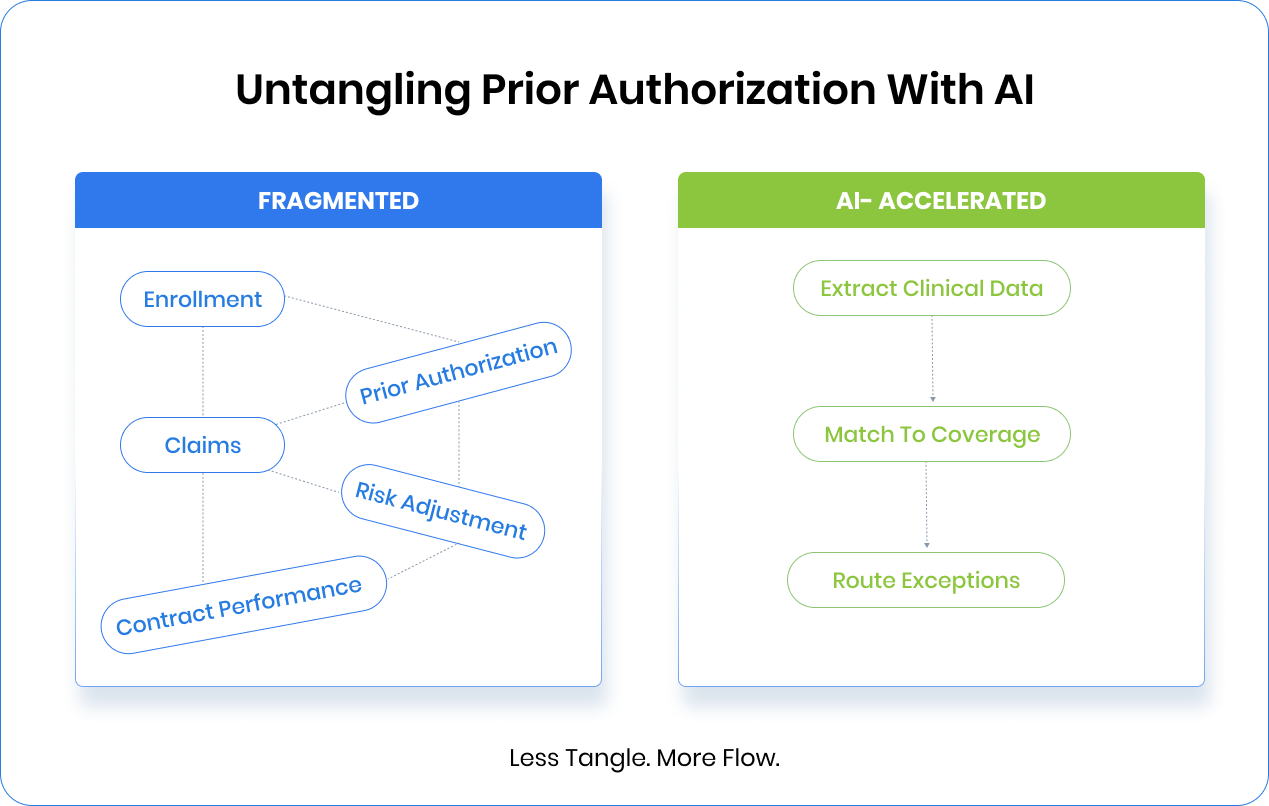
A crucial process in the complex web of healthcare operations, the most essential function that prior authorization performs is ensuring the appropriate, efficient, and economic use of resources. At the same time, the process is cumbersome, especially considering the scale of workflows involved in the administration of Medicare Advantage and other large government programs. Adopting modern technologies — AI prior authorization solutions in particular — can make PA operations more efficient both in terms of time and cost. For instance, AI-powered prior authorization software can accelerate requests by extracting necessary information from clinical documentation, matching requests against the health plan’s eligibility and coverage rules, and routing exceptions for human judgment. This is what AI in prior authorization looks like in practice, rather than as a marketing label. Healthcare AI for prior authorization is also moving beyond document review: a growing set of prior authorization ai companies now offer ai agents that handle prior authorization calls and follow-ups directly with provider offices, and early adopters are experimenting with top ai voice agents for prior authorization to manage the phone- and fax-based volume that automation has historically struggled with.
Choosing Prior Authorization Software
Not every tool marketed as healthcare prior authorization software delivers the same value. AI for prior authorization can range from a narrow prior authorization ai agent bolted onto an existing portal, to a full prior authorization software system that reworks the entire intake-to-decision workflow. Whether a health plan is evaluating an ai prior authorization software option or looking at electronic prior authorization software to replace fax-based intake, medical prior authorization software to support clinical review, or broader prior authorization software for healthcare meant to unify multiple lines of business, the evaluation questions are largely the same: does it integrate with existing systems, is its reasoning auditable, and does it keep a human reviewer in the loop for adverse decisions. For a full breakdown of what to look for — and how to evaluate prior authorization software vendors — see our prior authorization software buyer’s guide.
Where Automated Prior Authorization Is Headed
What healthcare organizations need today are AI-powered platforms that do not treat prior authorization as an isolated process but connect it within existing workflows. To illustrate, HealthOS Plan, a dedicated health plan administration portal built by HealthAxis, unifies enrollment, claims, prior authorizations, risk adjustment, and contract performance within one connected environment. This is where the future of the prior authorization process needs to head — toward automated prior authorization that is connected, intelligent, efficient, and transparent, while keeping human oversight in place. Whether that future arrives through an established platform or a newer, AI-first entrant may matter less than whether the automated prior authorization software chosen is built as part of a connected system rather than a standalone tool.
Frequently Asked Questions
What is prior authorization in healthcare?
Prior authorization is a mechanism used by health plans that requires providers to obtain approval before certain services, treatments, medications, or procedures can be provided.
Why is prior authorization required?
Health plans use prior authorization to evaluate whether certain services, treatments, equipment, or prescriptions are medically necessary, covered by the member’s plan, and appropriate for treating the patient’s condition.
How long does prior authorization take?
Timelines vary by plan and request type. Standard reviews can usually take up to 30 days or longer, while urgent requests are generally processed faster, typically within 3 days.
Does prior authorization guarantee payment?
No. Prior authorization confirms that a requested service meets the plan’s requirements for prior approval, but payment can still depend on eligibility, coverage, coding, and other claims requirements.
Can prior authorization be renewed?
Yes. Some authorizations are valid only for a specific period of time or number of services. For ongoing treatments, the physician will need to request a renewal or submit a new authorization with updated information.
What happens if prior authorization is denied?
In case a PA is denied, the provider or member has the option to appeal the decision and request a reconsideration by submitting additional information. The current evidence suggests that an appeal is likely to overturn the initial denial.
What is prior authorization software?
Prior authorization software is a technology platform that helps providers and health plans submit, track, and process prior authorization requests electronically instead of manually — often using AI to extract documentation, check medical necessity against coverage rules, and route exceptions to human reviewers, reducing turnaround time and administrative burden.
See HealthAxis in action
Get a personalized walkthrough of HealthOS and the Aipass™ intelligence behind it — mapped to the workflows you run today.